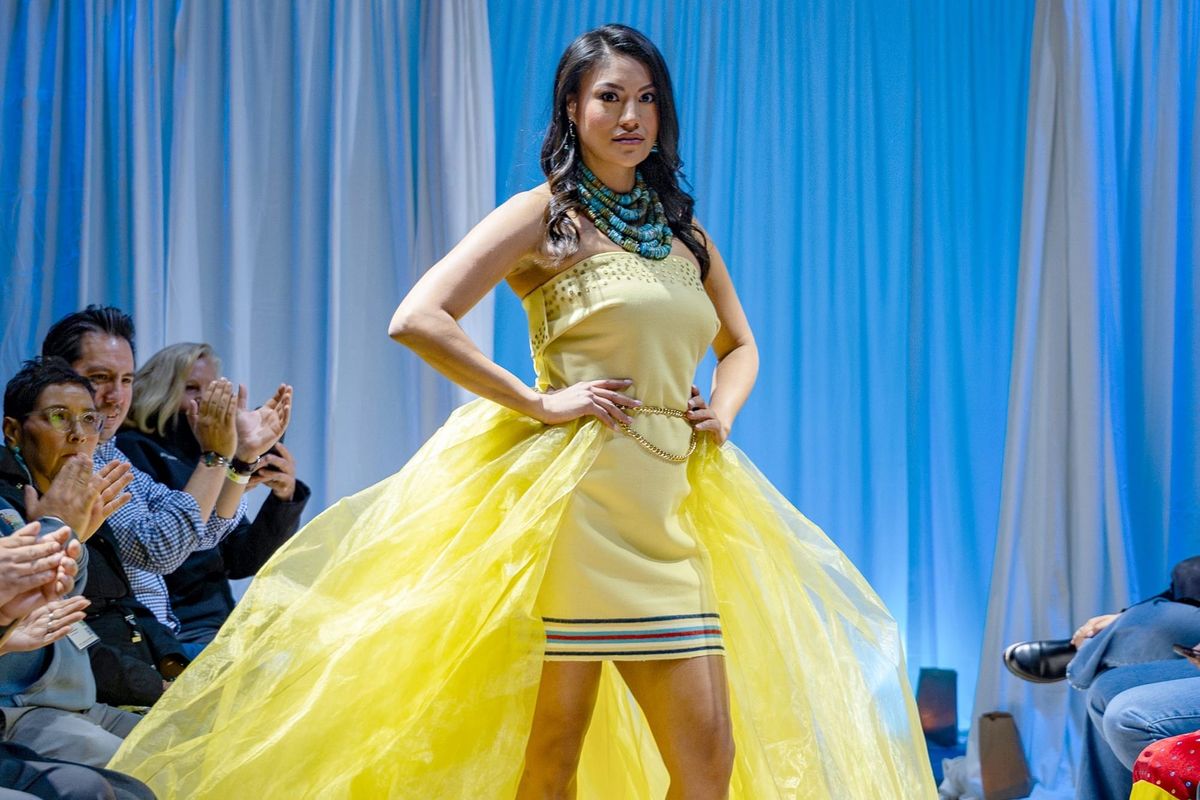
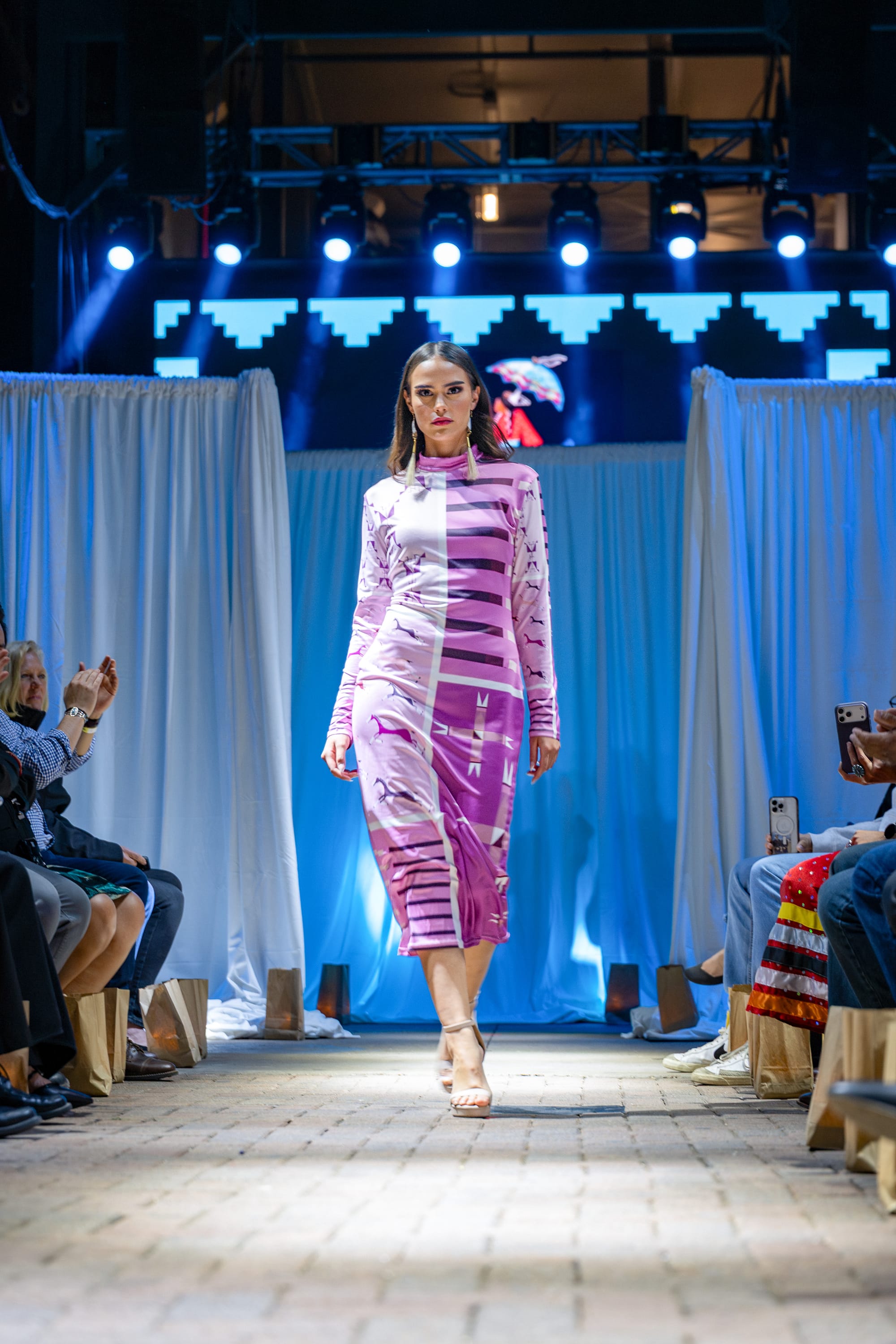
Miss Universe Canada 2024 Ashley Callingbull for JG Indie
Throughout SXSW, March 12-18, badgeholders experienced the power and excitement of the Texas-sized conference and celebration from the main festival footprint. But, if they were curious enough to venture off the beaten path, they could stumble on a doorway to someplace else while still deep in the heart of Austin.
Each year, the international music, film and innovation festival plays host to “Houses,” venues that showcase the creativity, culture and cuisine of places across the globe. Countries like Germany, Japan and Poland had houses. So did the state known as the Land of Enchantment—New Mexico.
On Monday, March 16, New Mexico House kicked into high gear with a full day of innovative programming. After a day of invigorating panels on topics like energy, film production and entrepreneurship, the House transformed into a celebration of Indigenous art and culture, offering a runway presentation celebrating three prolific and award-winning Indigenous designers.
Sage Mountainflower, one of the presenting designers, said it’s an “exciting” time to be an Indigenous designer because of the contrast of where American society has been since colonizers came to the continent.
“I grew up knowing that it was shameful to be Native American, it was shameful to be Indian, you know?” she says. “So being able to bring it out in this venue, this whole idea of it is exciting because it shows our resilience.”
To further showcase the artistic abilities of Indigenous people across the country, the three designers selected all Indigenous models to wear these Native fashions with pride.
JG Indie
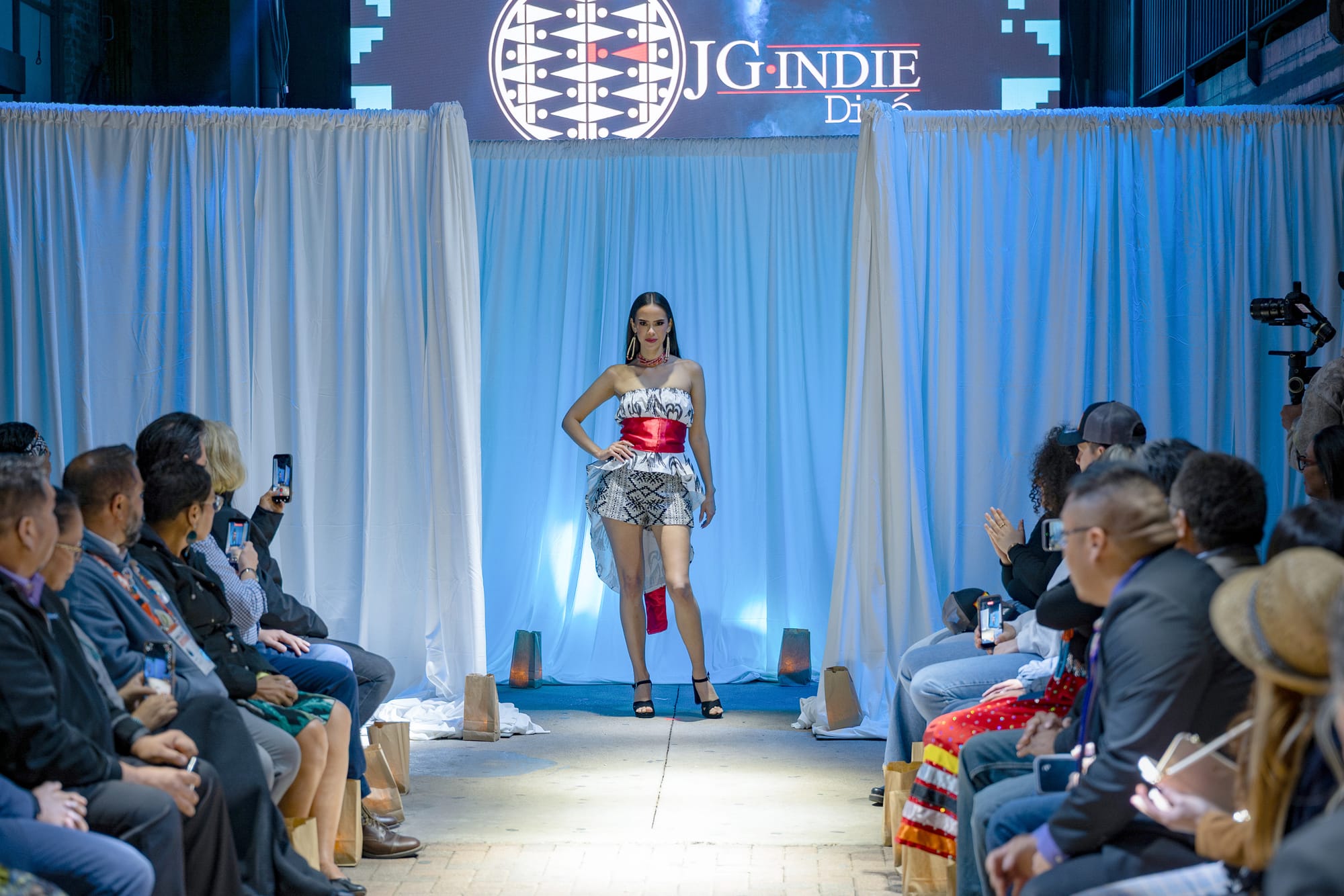
“I label myself as an urban Indigenous designer,” says Jolonzo Guy-Goldtooth, who blends his Diné (Navajo) heritage with contemporary and international influences in the way he designs, drapes and constructs clothing for his brand JG Indie.
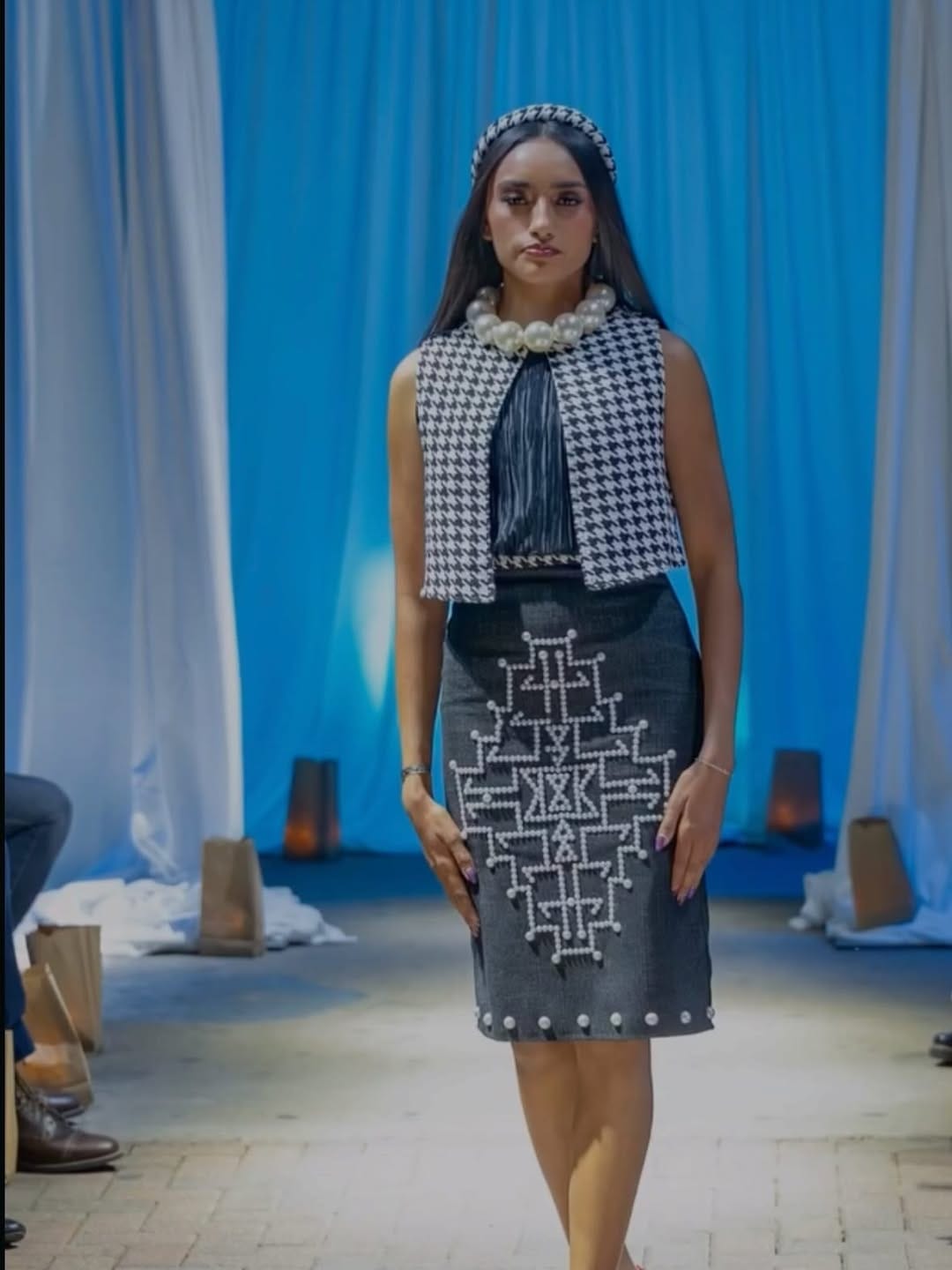
His perspective on the traditional women’s Chanel suit, one of his 14 looks presented during the New Mexico House fashion show, exemplifies his design philosophy. Audiences see typical elements of this garment: tweed, jacket and pencil skirt. Where things diverge are pearl motifs set into the skirt. On the front of the skirt is a traditional design called Two Grey Hills sourced from Navajo rug weaving. When the model, Miss Three Crosses Anistacia Aragon, turns around on the runway, viewers see another repeating triangular pearl motif on the back of the skirt framing the zipper to represent the spine.
“A concept that I like to show within my work is strong Indigenous women,” says Goldtooth on his other creative influences. “We have our aesthetic, our designs, but where I get my knowledge and my wisdom specifically is that relationship and that strong love for the women within my culture.” As it was his grandmothers who taught him how to sew, it’s only fitting now that he honors their legacy in every garment he touches.
Goldtooth has presented his fashions at the inaugural Indigenous New York Fashion Week and is signed on with Teton Trade Cloth by Lenape, a textiles and heirloom goods brand, which is headquartered in Bartlesville. You can find and follow Goldtooth on his website at jgindie.com or Instagram at @jg_indie.
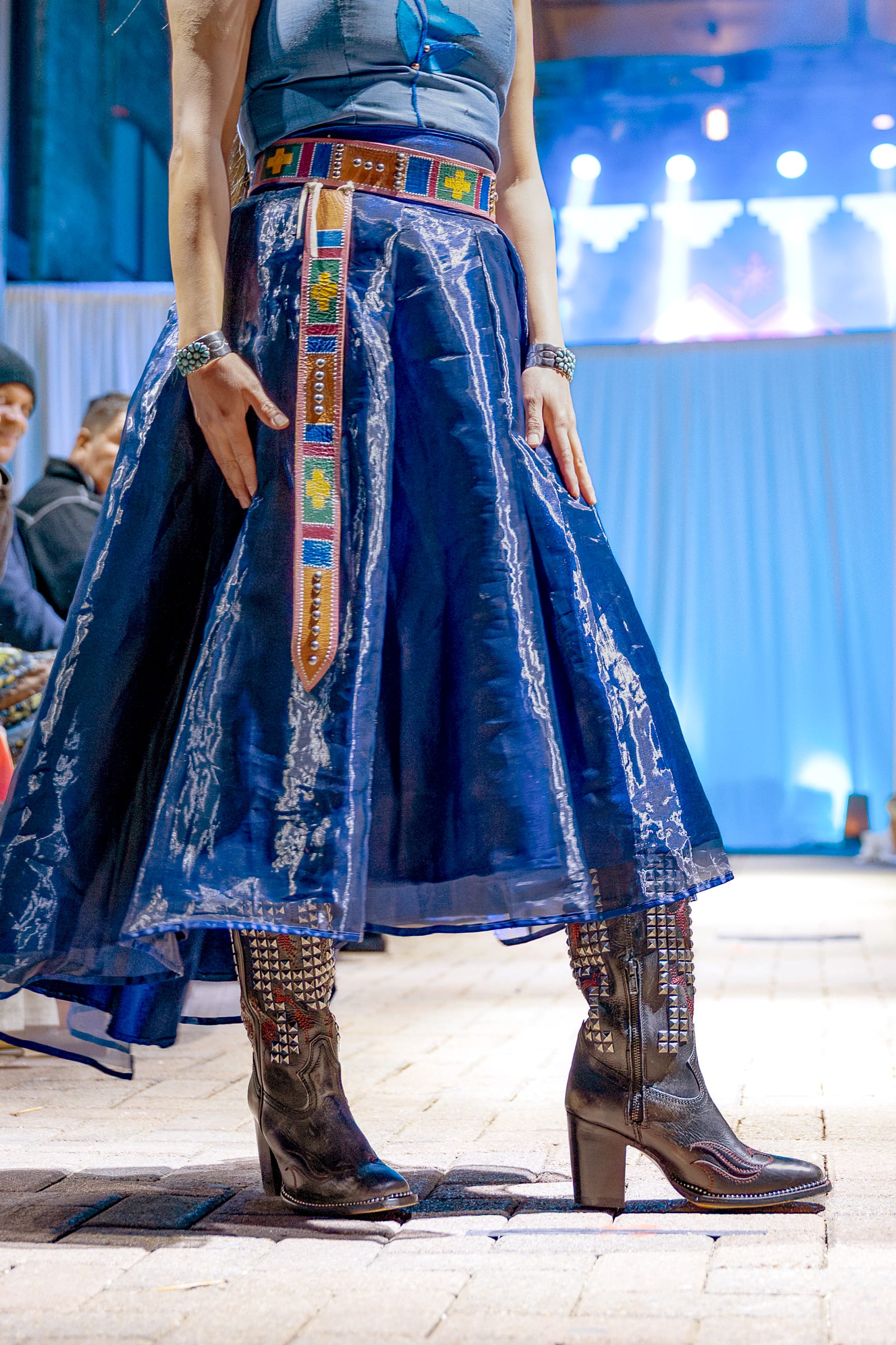
LEFT: Miss Three Crosses 2026 Anistacia Aragon wearing Goldtooth’s take on Chanel, RIGHT: Shenoa Jones for Sage Mountainflower’s Indigo Threads collection
Sage Mountainflower
Sage Mountainflower, of Ohkay Owingeh, Taos Pueblo and Diné (Navajo) heritage, had been making and beading her children’s pow-wow and ceremonial garments for 32 years, but didn’t start working as a fashion designer until 2018. The collection she presented at New Mexico House—Indigo Threads—was all made from recycled, upcycled and raw denim.
“The geology really played into this collection. Older rock is in layers, so that’s why you have different layers of color,” explains Mountainflower on how the landscape she observed at Estudio Corazón, an artist residency program at Ghost Ranch in New Mexico, inspired the collection.
Mountainflower carries a deep commitment to her community, feeling called to return home with the knowledge and experiences she’s gathered in the world and share them with her village. She likens this process to taking traditional dances out into public spaces—performing, refining and workshopping them—then bringing them back home once they’ve been fully shaped and strengthened.
“[The community] don’t get to come to shows like this. They don’t get to travel like I do. So whatever I take out, I’ll bring what I can to the Pueblo,” says Mountainflower. “Because if we take out a dance, we have to ask for it, and then when we finish the dance, then we have to bring it back in, right? So then that’s like before I take it out, say my prayers and come here. Now, when I go home, you know it’s gonna travel back with me, but then I have to share it with my community.”
Mountainflower has presented her prolific work during New York, Milan and Paris Fashion Weeks and has been the subject of a micro-doc by international tech brand Square. You can find and follow her on Instagram at @sagemountainflower.
Red Berry Woman
Before the Red Berry Woman runway presentation, Native dancers of all ages filled the space with movement and energy. This vitality was carried into the collection, too, as the leading color of every design was a vibrant pink, including the outfit worn by the collection’s designer Norma Baker-Flying Horse.
Baker-Flying Horse is an enrolled member of the Hidatsa of the Mandan Hidatsa Arikara (TAT) and a member of the Dakota Sioux and Assiniboine tribes. She designed the dress of activist Alice Brownotter for the stage of the 2018 Oscars and model Quannah Chasinghorse for the 2024 Oscars Red Carpet (a gown Anna Wintour described as one of her favorites of that year’s ceremonies), and received a Visual Arts Cultural Recognition Emmy in 2023—to name some notable accomplishments. Her brand, Red Berry Woman, has graced international runways and fashion weeks.
Baker-Flying Horse, who grew up in Oklahoma and Alaska before settling in North Dakota, said her artistic inspiration traces back to her family.
“It goes back to who I was taught by; it was by my grandmother. She taught me to bead, and the designs that she taught me to do were Dakota Sioux designs,” says Baker-Flying Horse, who also noted that the designs can tell stories. “Anytime I’m designing something, these designs come to mind; it’s all I think about.”
Baker-Flying Horse also points to her grandmother as giving her the life advice that has gotten her to the level of success she has now.
“I don’t really have plans, because my grandma said not to do that. You’re not supposed to plan anything. It won’t work out. So I never have, and it’s gotten me this far. I’m just gonna follow the momentum, whatever, wherever I go.”
You can find and follow Baker-Flying Horse on her website at redberrywoman.com or on Instagram at @red_berry_woman.
LEFT: Fern Hoover for JG Indie, RIGHT: Kiren Hoover for Red Berry Woman
Land of Enchantment
As part of the runway presentation, New Mexico House selected a surprise celebrity model to join the catwalk. Ashley Callingbull, a citizen of the Enoch Cree Nation, has a prolific modeling, acting and public speaking career and was the first Indigenous woman to win Miss Universe Canada in 2024. Callingbull noted the importance of what organizations like New Mexico House are doing for Indigenous artists through this runway presentation.
“It’s really empowering,” says Callingbull, who is also a First Nations activist. “It’s powerful to wear all Indigenous designs. Being an Indigenous person, and the fact that we’re being seen and represented, and we’re in these spaces showing that Indigenous people are rising—it’s really powerful. It’s representation that matters."
The link has been copied!
Your link has expired. Please request a new one.
Your link has expired. Please request a new one.
Your link has expired. Please request a new one.
Great! You've successfully signed up.
Great! You've successfully signed up.
Welcome back! You've successfully signed in.
Success! You now have access to additional content.