
Image & Form
Roger Deakins’ fascinating facets, in film and beyond

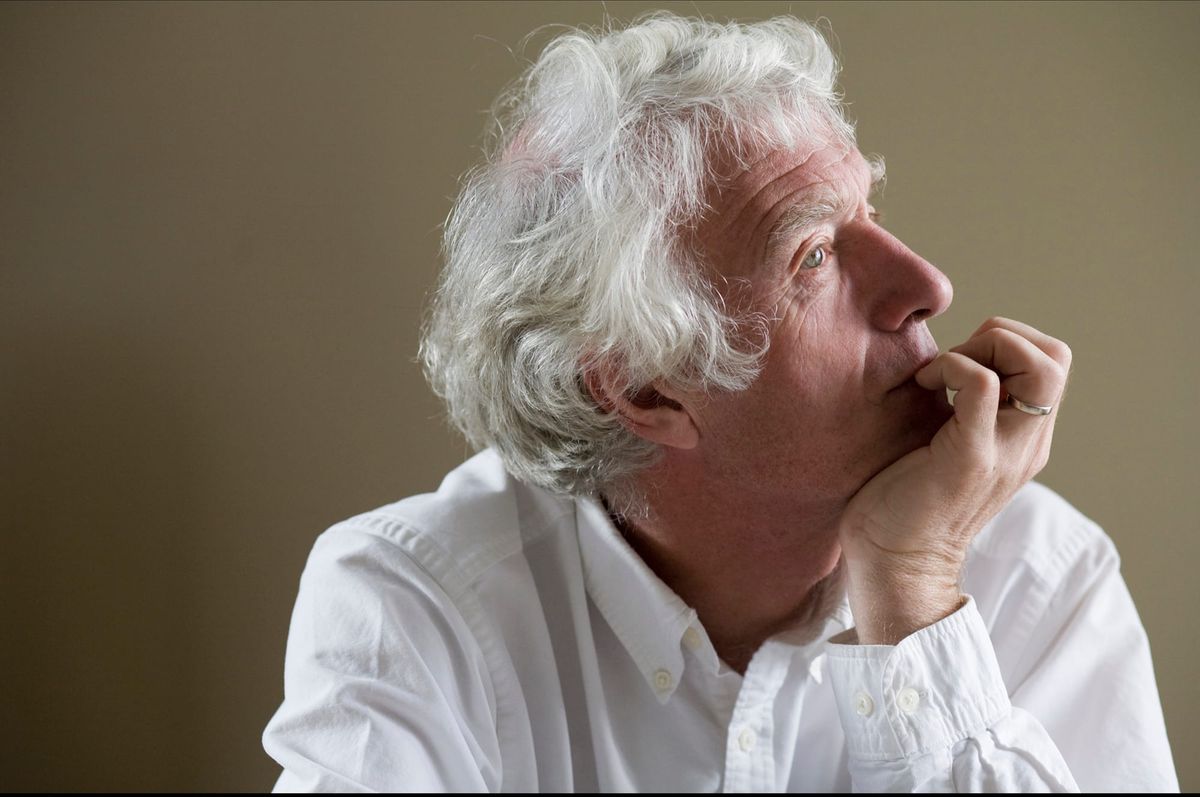
You may not know his name, but if you have been to a movie theater in the past five decades, you more than likely have seen his work. Roger Deakins is responsible for the way movie-goers remember some of the most iconic films in Hollywood history.
As an award-winning cinematographer, Deakins is the person tasked with turning simple scenes from words on a page into a visual masterpiece that has fans talking about it long after they leave the theater. Over his nearly 50-year career, he’s made that happen countless times.
Whether it was the use of color in Blade Runner 2049 or his framing in 1917, Deakins’ work has been studied and imitated throughout 70 films, which have garnered him 16 Oscar nominations for titles such as The Shawshank Redemption, Fargo, Skyfall and O Brother, Where Art Thou?
Yet, when asked to describe the duties of a cinematographer, Deakins didn’t talk about choosing the right camera and lenses or even making sure light catches the best side of an A-List actor. Although he is one of the few people who was made a Commander of the Order of the British Empire and given the honor of knighthood by the Queen of England, he still prefers the title of storyteller.
“The most important thing is storytelling,” Deakins says in an exclusive interview. “It’s not the technique. It’s not producing flashy images. It’s creating images that reflect the story.”
It’s that focus on storytelling that Deakins has carried into the next chapters of his career. The 76-year-old was in Oklahoma in late February to celebrate his half-century in the movie business, but also to highlight the additional titles of author, photographer and even podcaster on his illustrious resume.
Perhaps none of Deakins’ new endeavors was more unexpected than podcast host. He partnered with his wife, Isabella James Deakins, to form the podcast “Team Deakins,” which they describe as an ongoing conversation about cinematography and the film business. Past guests have included actors Kate Winslet and Jake Gyllenhaal, producer Clayton Townsend, director Steven Soderbergh and composer Nicholas Britell.
With more than 345 episodes under their belts, the success of “Team Deakins” has completely surprised the duo.
“It started out quite different because we were doing some publicity for 1917 and every time after the Q&As, we’d come off the set and then people would come up to us and they were always asking the same questions,” James says. “So, I said to Roger, ‘Well, what if we do a podcast that answers these questions?’ And Roger went, ‘Well, what’s a podcast?’ Because he was not a podcast guy. I’m not particularly either.”
After figuring out exactly what went into creating a podcast, the first “Team Deakins” episode—titled “Beginnings”—went out on April 25, 2020. Since then, it has grown and morphed into something quite different from what they initially expected.
“From starting from a very technical point, we ended up talking to all these people and it became more,” James says. “It became a conversation that people could eavesdrop on and between people that do this and to hear how people approach things, how they’re passionate about it and how they keep their passion in this crazy business. Yeah, it just expanded.”
While “Team Deakins” was creating a unique space in the podcast world, Deakins was also working on his second book, Reflections: On Cinematography. After two years of writing, it hit the bookstands in November 2025.
Much like the podcast, Deakins wanted Reflections to not only provide an inside look at his profession, but also produce something people from all areas of life would be invested in reading.
“I didn’t want it to be a technical book,” Deakins says. “I’m not sure what the publishers wanted; whether they wanted us to sort of tell lots of stories about actors and stuff in Hollywood, and I didn’t want that either. So, I wanted to be much more personal. It’s a kind of mixture of my career path, I suppose, with some technical information about how I worked on certain films, how I worked with directors on certain films and how certain images came about.”
Unlike movies, for which everything is on a schedule and the work has to be completed by a certain date, Deakins had to get accustomed to the newfound freedom of being a self-employed author.
“I found the biggest problem was to sort of keep it within a reasonable length,” he says. “Because I got so many stories and so many experiences. Thankfully, the publishers were really supportive. It’s bigger than they initially imagined, but it’s still within a price range that we wanted it to be. We didn’t want it to be an expensive coffee table [book], but we wanted it to be something accessible to, you know, a young student or anybody interested in film.”
While Deakins was able to talk about the podcast and book and celebrate his films with the people of Tulsa, the main focus of his trek to Oklahoma was his still photography.
Deakins made the trip to open his photo exhibition Still Light at The Hulett Collection, which features his newest photographs that were added to his print gallery at the Hulett.
“Running parallel to his celebrated career in cinema, the photographs in Still Light are rooted in observation rather than spectacle—quiet moments shaped by light, timing and an attentiveness to place,” says Michael Hulett, owner of the Hulett Collection. “Seen together, the works reveal a consistent visual philosophy grounded in restraint, patience and the expressive potential of the everyday.”
Deakins actually began his career as a photographer before he discovered he could tell stories with documentaries (Zimbabwe, Eritrea—Behind Enemy Lines). That would lead to music videos, big-budget feature films, Academy Awards and world-wide recognition.
However, some 50 years later, Deakins decided to pick up a still camera again to indulge his first passion.
“For many years, I didn’t really carry a camera,” he says. “I felt it was just too much of a distraction. And I don’t take photographs when I’m actually working. “
He did make an exception back in 2014 while working on a film in New Mexico.
“When I was shooting Sicario, we got shut down one day because these thunderstorms came through and they deemed it too risky for the crew to be shooting in that weather,” Deakins recounts. “I got in my car and drove to this location I knew to wait for a photograph. I wanted to get a photograph with a bolt of lightning hitting this bar that I knew out in the middle of nowhere. And sure enough, I got there, I waited for about an hour with my finger on the trigger and this bolt of lightning came down. I got this photograph of a bolt of lightning hitting this bar. And it’s not often I have a photograph in my mind, but that was one I deliberately went to find.”
Instead of a sound stage or a big movie set, Deakins finds everyday life the best setting for his current photography projects. When visiting different cities and countries around the world, he tends to get up early and walk around alone with just a camera in his hands.
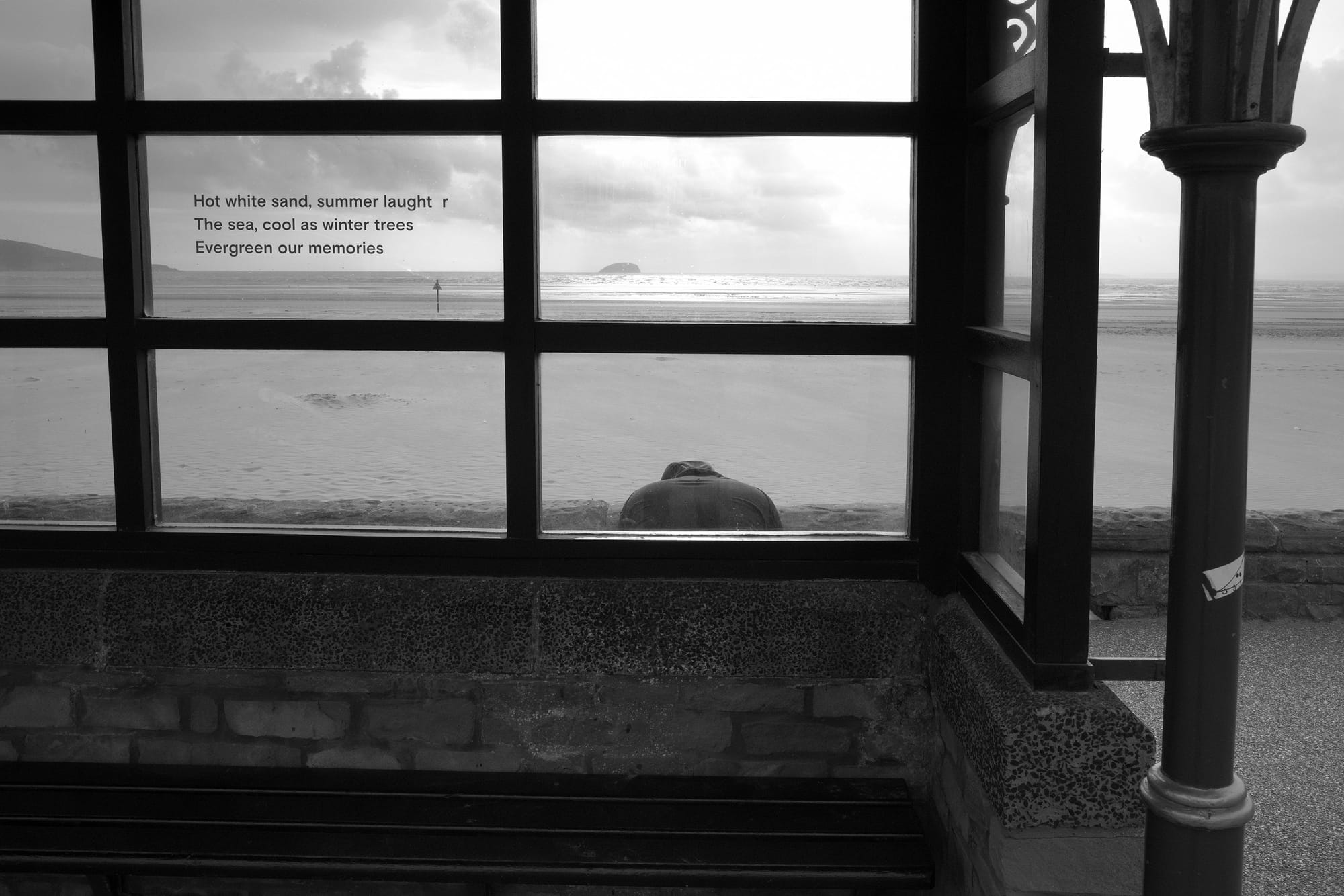
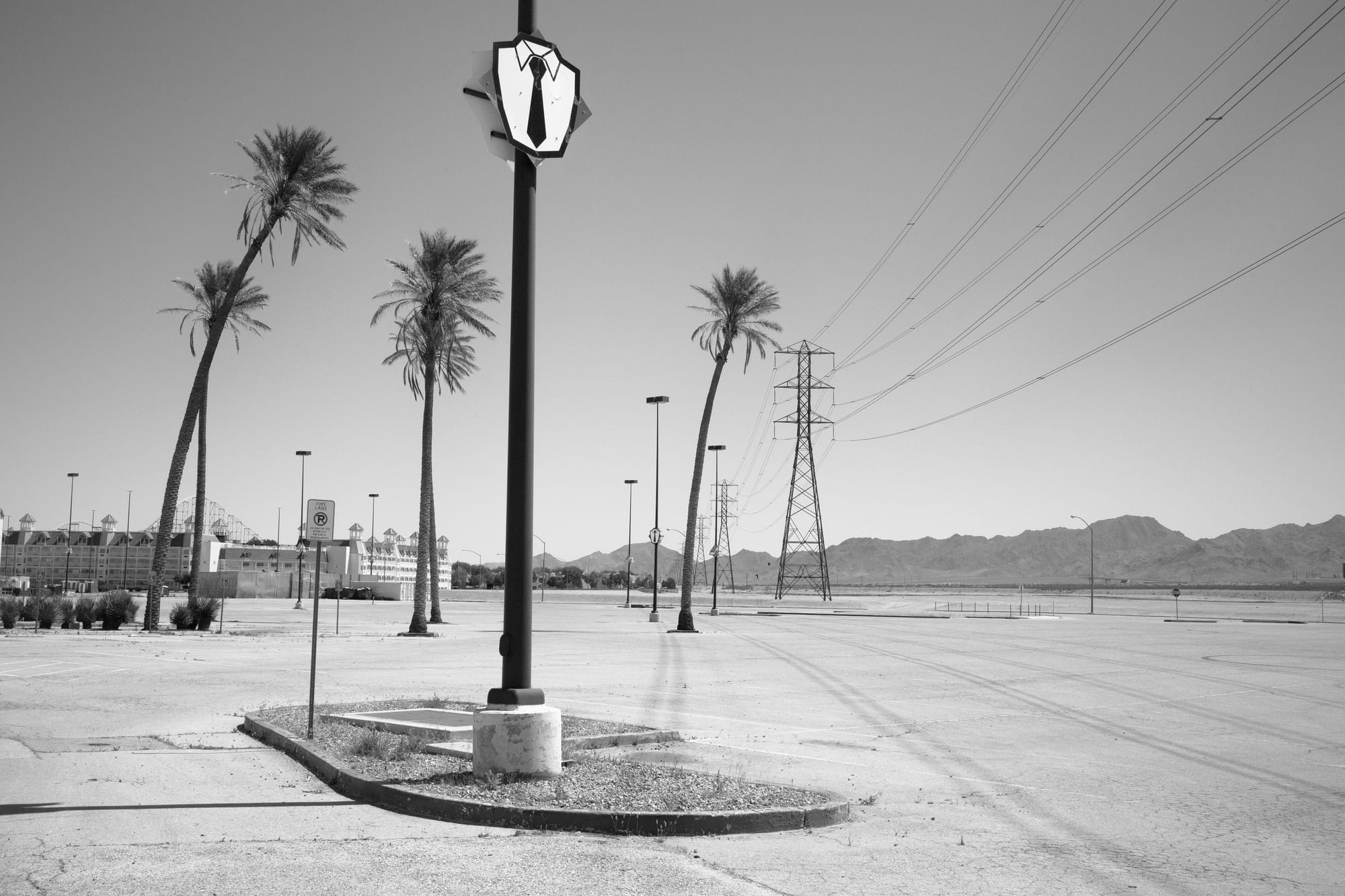
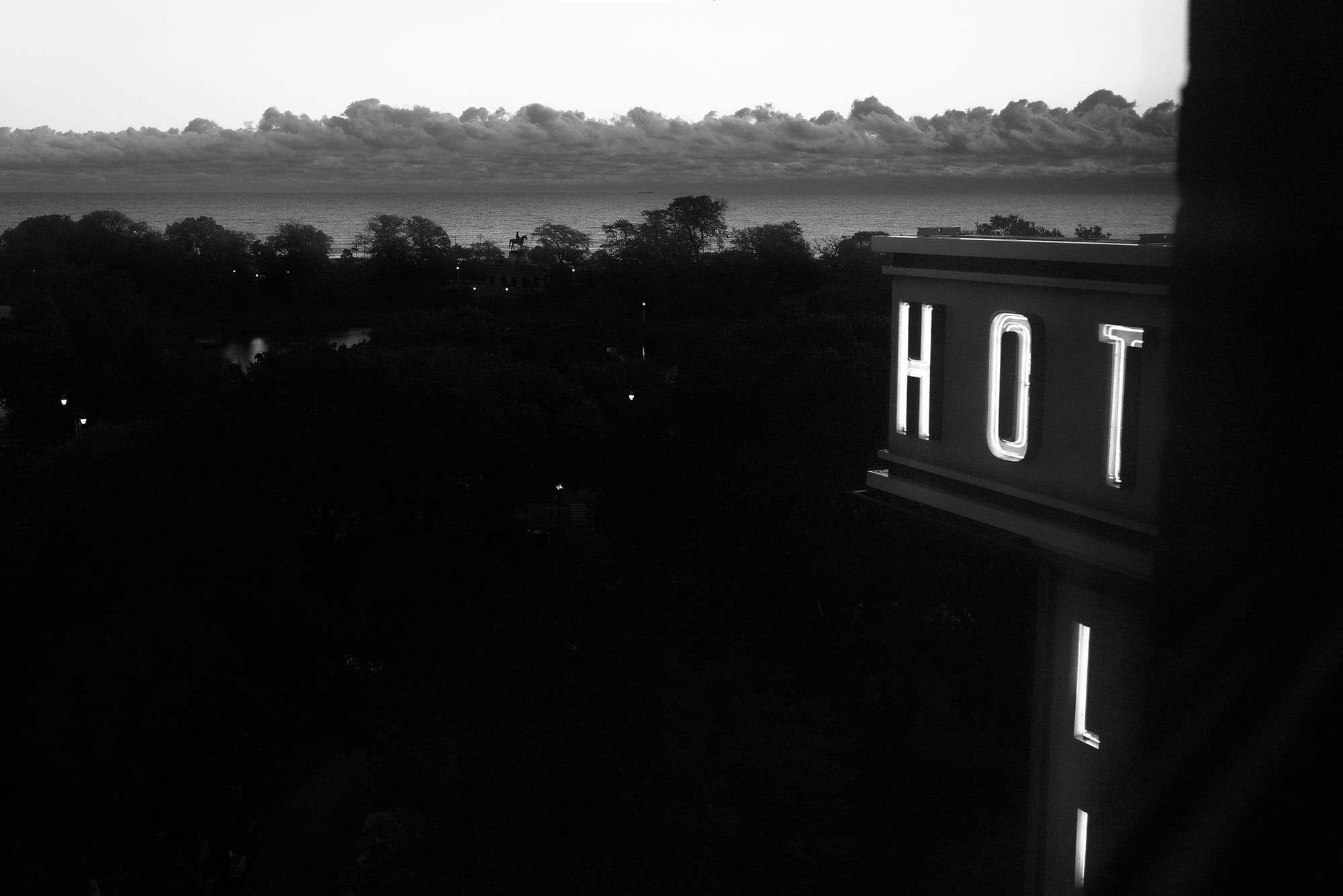
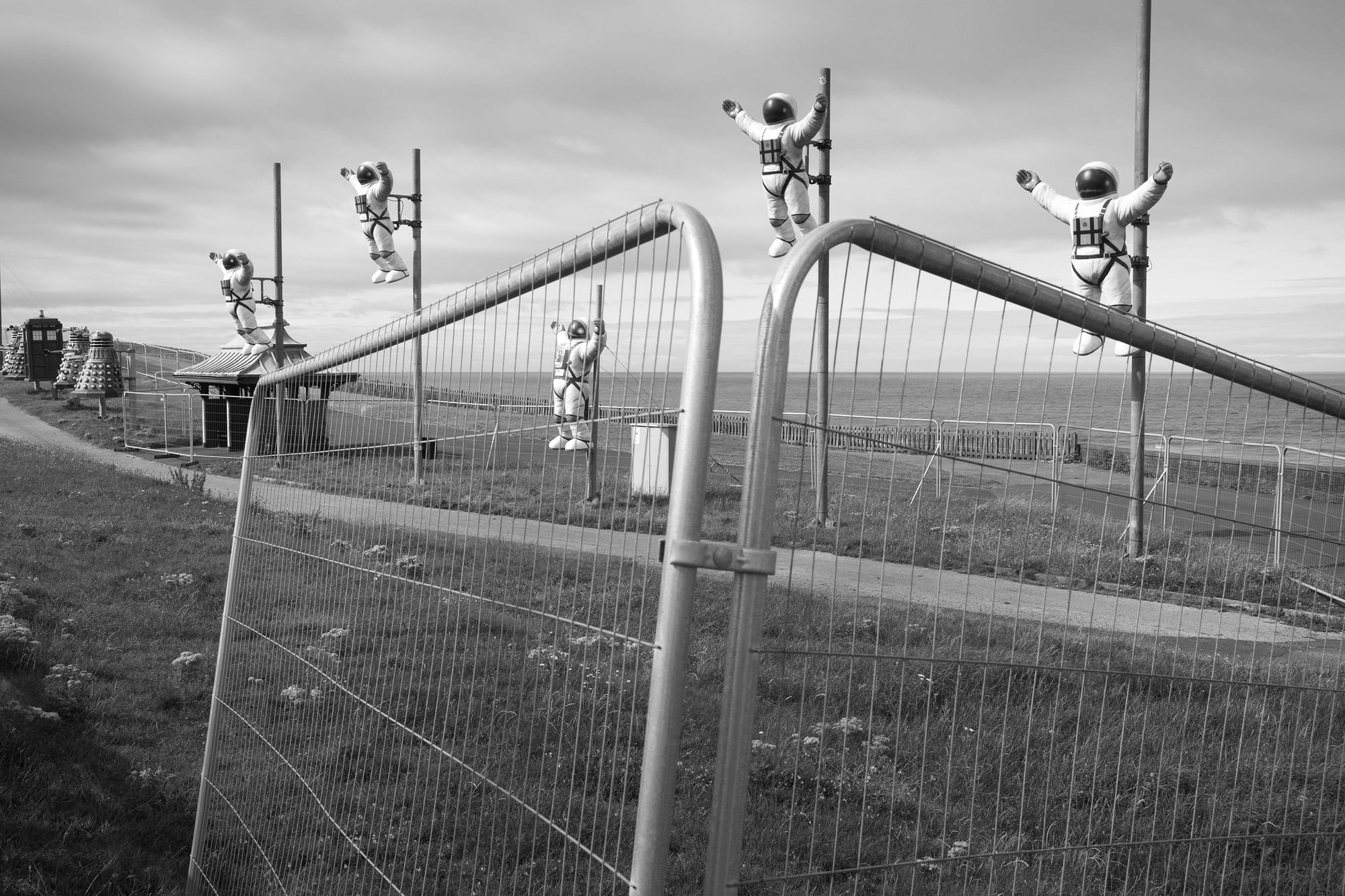
“They’re very minimal,” Deakins says of his work. “They’re all street photography. They’re all just found moments, but they oftentimes have a sense of irony and humor. And they’re also kind of lonely, really, I suppose. They’re kind of empty and spare and often quite melancholy—I’m drawn to those kinds of photographs.”
His print collection includes titles such as “The Last Pandas,” “Evergreen Memories,” “Half Board” and “The End.” Using black and white film primarily, his images are meant to make the viewer think about what they are looking at.
“I can take photographs, as James says, that are kind of funny,” Deakins says. “But I do like the photographs that are kind of reflective. It’s often somebody in a funny situation, but I’m not poking fun of them. I hope I’m not. I’m kind of celebrating the oddness of life, really.”
He was able to combine his new and old endeavors when “Team Deakins” had celebrated Magnum photographers Harry Gruyaert and Alex Webb as guests. Both had been idols of his.
“I’ve got to say, I get more satisfaction from my still photographs. Maybe I always have. I just love making images.” –Roger Deakins
“We talked to them about their process taking stills and their career, and both of them had actually started doing a bit of film work,” Deakins explains. “But neither of them liked the fact that on a film you have to collaborate with a lot of people and there’s usually a director sort of saying, ‘Well, I want it this way’ or whatever. And they both said, ‘We like our freedom and we like to be able to take the picture we want to take.’”
Despite the success and awards he has garnered in the film industry, the lauded cinematographer finds the work he does with still photography even more gratifying. He is still telling stories, but they are his stories.
“I’ve got to say, I get more satisfaction from my still photographs,” Deakins says. “Maybe I always have. I just love making images. But there’s something so personal about the still photographs I take; even if nobody else likes them, it doesn’t matter. They say something to me.” •
It would be difficult to find anyone who has made more of a mark on filmmaking than Roger Deakins. With more than 70 feature films to his credit, the cinematographer has been at the heart of some of the most important films of the past half-century.
But even more than wanting to talk about his films such as Barton Fink, The Man Who Wasn’t There or Sicario (to name just a few), I wanted to know which films inspired Deakins and his wife, Isabella James. What movies they consider to be a must-watch was something I had to find out.
As expected, the responses did not disappoint. As someone who considers himself a cinephile, their answers were not what I was expecting. Anyone who could film the chilling coin flip scene in No Country for Old Men was definitely going to have some eclectic choices.
1. 1984 (Michael Radford)
“I think everybody should read Moby Dick, for one. And everybody should read 1984. (George) Orwell’s 1984. And they probably should all see the film 1984, that I actually worked as a cinematographer on.”
2. Army of Shadows (Jean-Pierre Melville)
“I think everybody should see a film called Army of Shadows, which is about the French resistance based on true events. I think everybody should see any and all of Andrei Tarkovsky’s films for a start, you know.”
3. Come and See (Elem Klimov)
“They should see a film called Come and See, about the Second World War in Belarus. And it’s actually a story that actually the director partly experienced.”
4. The Wild Bunch (Sam Peckinpah)
“Everybody should see The Wild Bunch. It’s a great movie, you know. Love it, love it, no doubt.”
5. Don’t Let’s Go to the Dogs Tonight (Embeth Davidtz)
“This year, there was a movie that came out that might be controversial, but it was Don’t Let’s Go to the Dogs Tonight. Just a little film. Simple film, but really moving.”
6. The Seed of the Sacred Fig (Mohammad Rasoulof)
“I think last year, the film that we both loved most, actually, was The Seed of the Sacred Fig. I thought that was a wonderful movie.”
7. “Das Boot”
“We’ve gone back because they did a movie, Das Boot, but they did it from a television show. So we go back and we see the television show because it allows the characters to develop more. And at the very end, and you’re with the Germans and these people, and at the very end, they get bombed and you feel horrible. And then you realize, ‘Wait a minute, I’m rooting for Nazis.’ It’s very, very sad.
“I remember when my father saw it. My father had been in the war. He said when he saw it, when the end came up and the docks the submarine was in were being bombed and these people being killed, he said, ‘I don’t know what to think. I mean, they’re the Germans and I fought against them for four years. But I feel really bad.’ Which … really said a lot because [he] was very anti-German. So, I mean, I think that’s good just because it makes you see another side. That’s what film can do.”
8. “Edge of Darkness”
“We recently saw an old—because we were talking with the director, because we see all these things before we talk to people—but an old BBC television series called ‘Edge of Darkness.’ And it just showed you how minimal you can be to tell a story and have shots that you don’t really know why they’re there, but they’re making you feel something. And so it was really good.”
