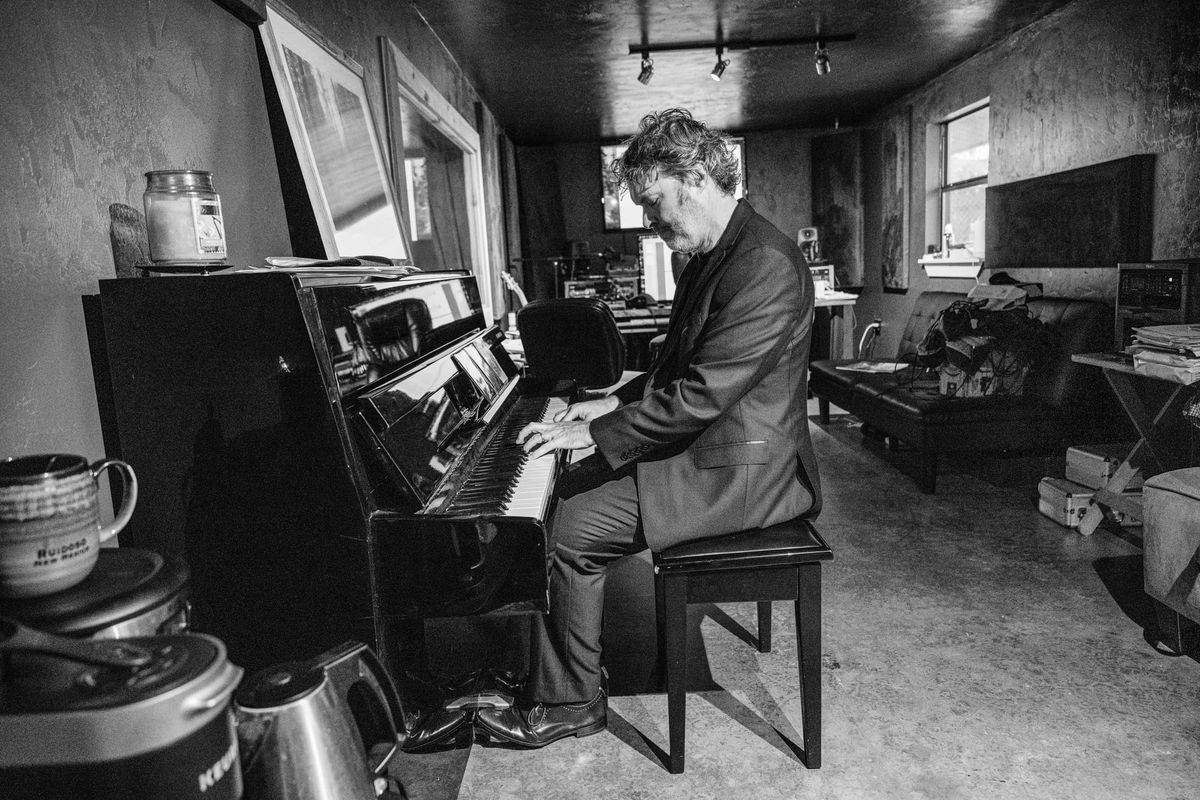
Composer Brian Byrne plays in his Purcell studio, photograph by Michael Kinney
It can be a surreal experience for Brian Byrne. Despite the numerous albums he has worked on and the multitude of rock and pop stars he has worked with, the Irish musician still gets giddy when he sees the effect his music has on fans.
“There are shows I’ve done where you go, and you hear two hours of your music, and it’s unbelievable,” Byrne says. “When you’re working on (the music), you forget that’s what it is about. And then you sit with an audience, and they’re paying for tickets to hear this show that’s two hours of your music. That’s awesome.”
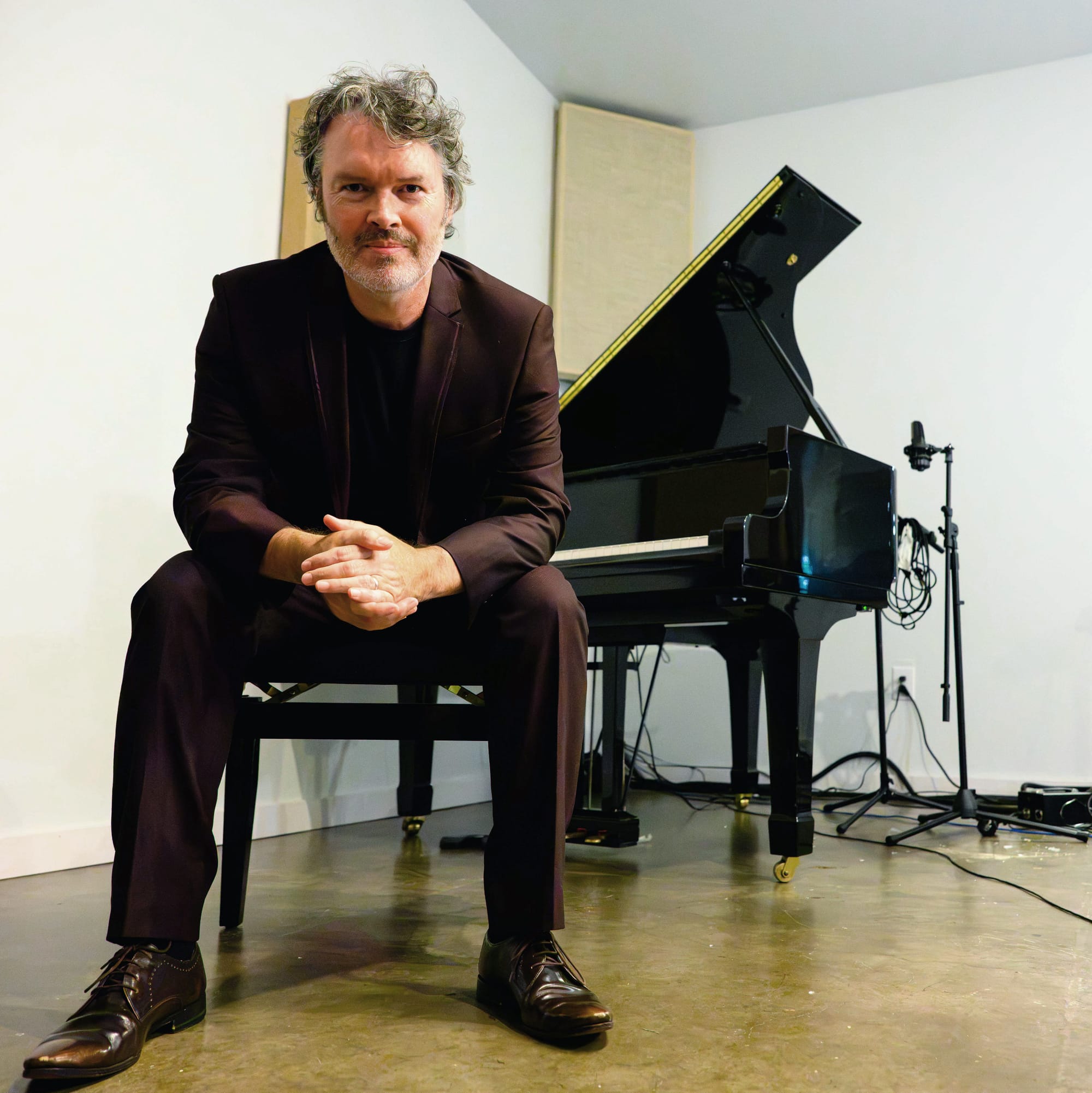
Byrne is from Navan, County Meath, Ireland—the same hometown as the fourth best James Bond (Pierce Brosnan). But it has been in the United States where the 50-year-old composer, conductor, producer, orchestrator and pianist has crafted a career that has put him in the same room as the biggest musical acts in the world who came looking for the Byrne sound.
From big movie scores to intimate jazz records, Byrne prides himself first and foremost on just being a piano player who loves to make music.
“I always wanted to create. And playing jazz piano is instant composition. If you think about what improvisation actually is, it’s coming up with a composition on the spot,” says Byrne. “So, if you slow it down, that’s composition. You can apply this to any genre. I studied classical, and I studied jazz. I kind of found it easy to write in different styles; as long as I loved the sound, I loved the project.”
In his 36 years in the business, Byrne has built a prolific career that includes composing the scores for 24 feature films and television productions, co-writing the music for Netflix’s “The Residence,” composing and orchestrating music for DreamWorks Animation’s The Croods: A New Age and Sony Pictures’ Hotel Transylvania: Transformania.
Byrne’s list of collaborations reads like an awards show. The likes of Barbra Streisand, Bono, Katy Perry, Pink, Sarah McLachlan, Sinéad O’Connor, Van Morrison, Alanis Morissette, Julian Lennon, The Corrs and Celtic Woman are just a few of the luminaries who he has worked alongside.
Despite having spent 17 years working in Los Angeles, the past six years of Byrne’s livelihood have taken place in one of the most unlikely of places: His backyard in Oklahoma.
Photography by Michael Kinney
After Byrne, his wife Kasey Jones and their two children (Asa and Roxy) moved to Purcell in 2018, he immediately began working to transform what had been a dilapidated auto shop into a state-of-the-art music studio.
“I saw this building and went, ‘That’s it. I can make this work.’ This was a garage. There was a lawnmower tractor in here, and there was oil spilled on the ground and dirty shelves,” Byrne says. “And so we had to gut it. We spent about a week just tearing everything down, and I’d say it probably took about eight or nine months to complete.”
The 1,200-square-foot studio would be easy to miss. Nestled in the heart of a nondescript neighborhood and sitting behind a two-story home, anyone who happened to venture into the backyard might assume it’s a large tool shed or a pool house.
Behind its heavy doors and soundproof walls, Byrne spends most of his days locked away with his soundboard, a baby grand piano, various other instruments and, most importantly, a coffee pot. It’s a setup he could never have afforded before taking up residence in Oklahoma. In Los Angeles, he said, it would have cost him more than $2 million.
“I never really had a space in L.A. that I was proud to bring people over to,” Byrne says. “I did a movie called Albert Nobbs, which I got a Golden Globe nomination for. But to work on that movie, I had to bring the director (Rodrigo García), the producer (Bonnie Curtis) and Glenn Close (Fatal Attraction, Mars Attacks, 101 Dalmatians). And they’d come over to our tiny little two-bedroom apartment, and I’m in one of the bedrooms, and the kids are sleeping there.”
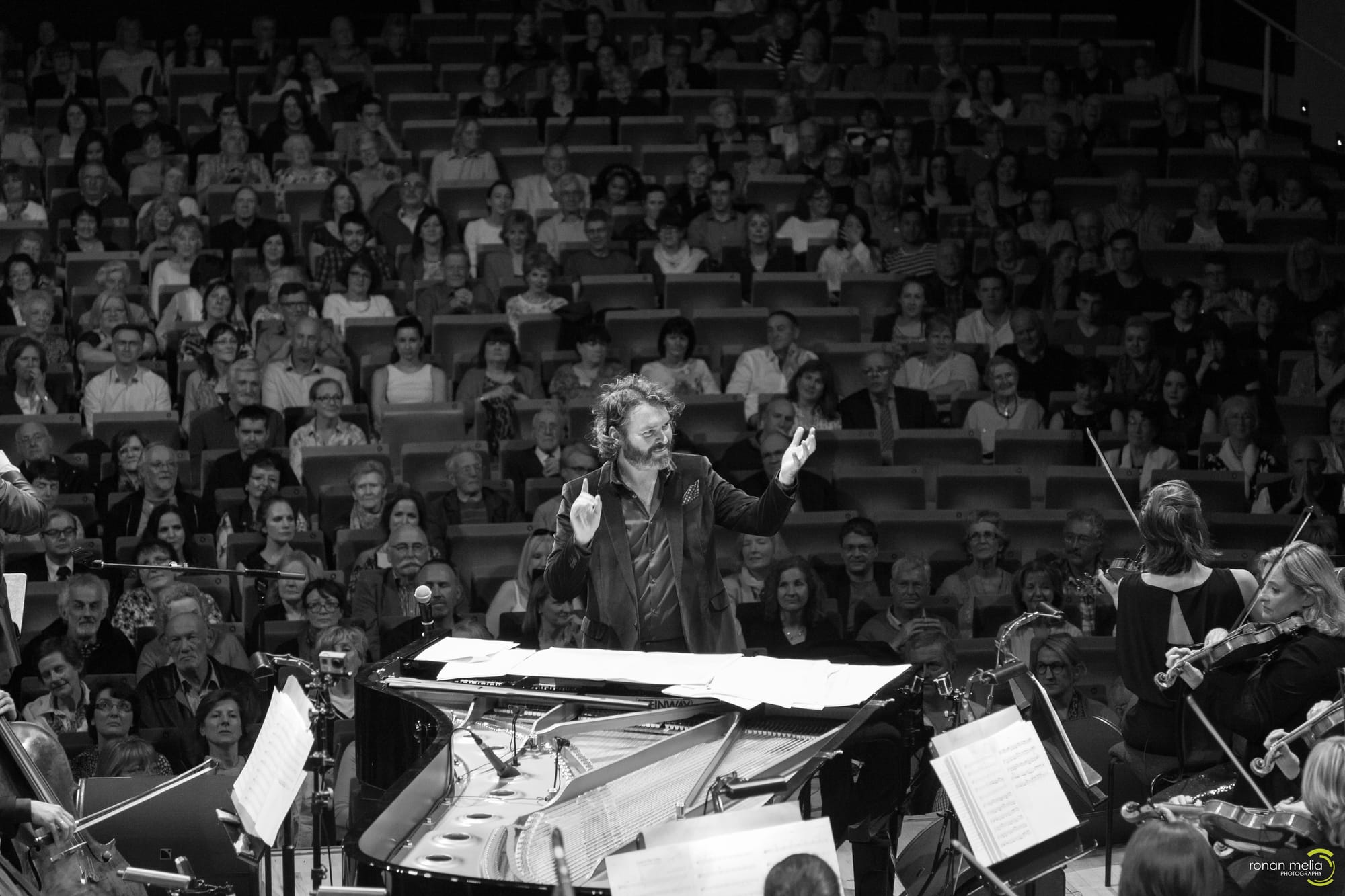
Nowadays, Byrne is more than happy to have people over to work in his studio. That includes the Oklahoma City Philharmonic, with whom he has partnered on two symphony concerts and projects like “From Chinatown to La La Land.”
Image courtesy of Ronan Melia Photography
Even its members were taken aback when they learned they would be making the short drive south on I-35 to work on their music.
“The Philharmonic, they were coming down to Purcell asking questions like ‘What’s this studio? Where is it? What are we doing? Why is this Irish guy here in the middle of Purcell?’ But we did it, and it worked out great,” Byrne says. “To have the ability to record an orchestra in your backyard is unbelievable. And I love it.”
Byrne doesn’t openly promote his studio, though. He knows he could make more money renting the space to others when he isn’t using it. However, in movie vernacular, it has become his Fortress of Solitude.
“I spend every day in here, and I love it. I absolutely love it,” he says. “And most of the stuff I’m doing is not in Oklahoma; it’s in Ireland or Los Angeles or London or wherever. And then occasionally I’ll do some Oklahoma stuff.”
Because of the composer’s ability to move from one discipline to another, it’s not hard for him to fill his time with projects.
“If something wasn’t working and not paying for a while, I could switch over and be an arranger,” says Byrne. “If the arranging gigs didn’t come in, then I could be a piano player, or I could be a conductor. That old school style of being able to kind of do it all. You have to have those.”
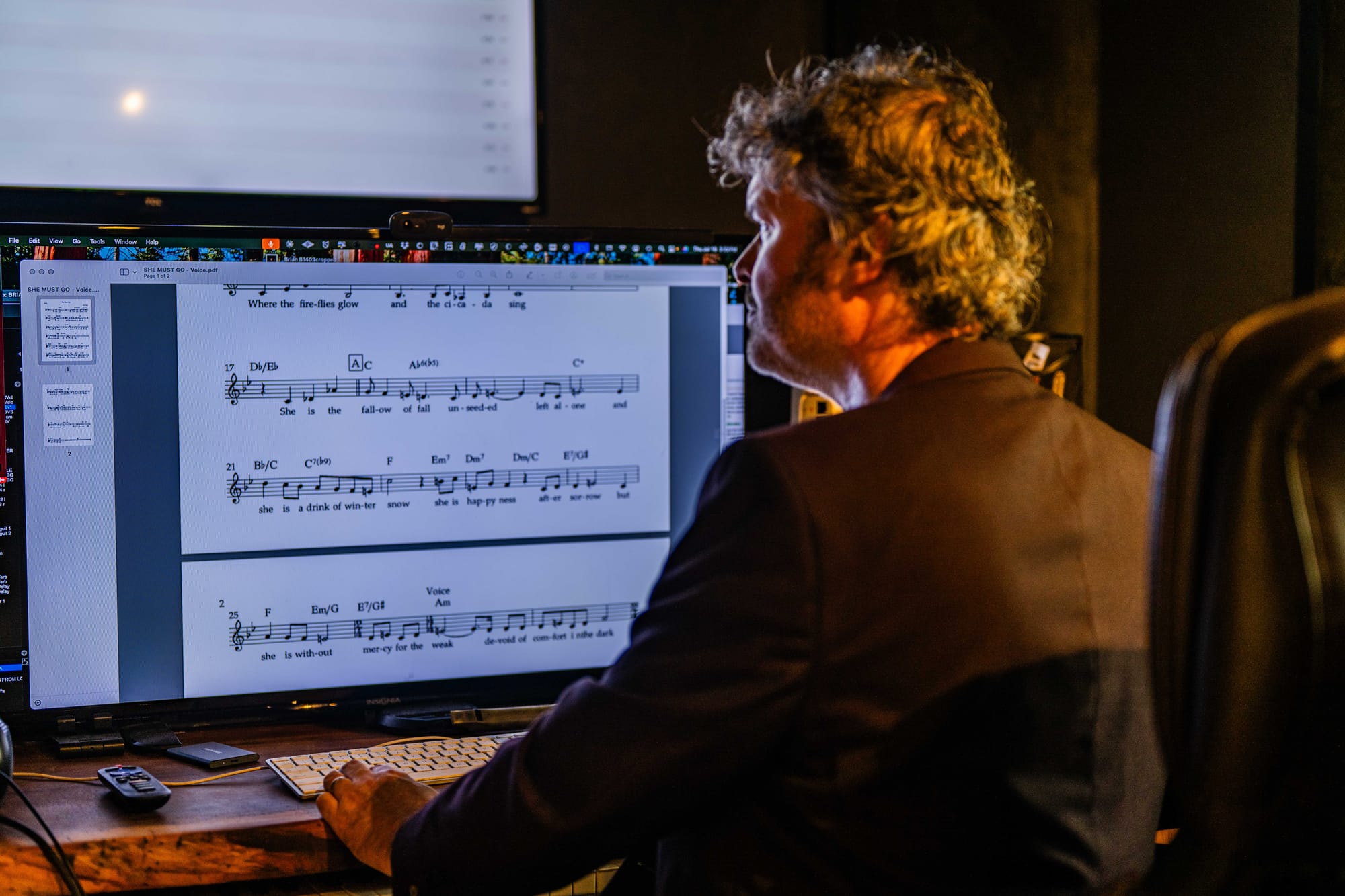
Thanks to technology, Byrne can be seated at his mixing board in Purcell and collaborate with other musicians around the world. They can create an entire symphony and never have to be in the same room.
While that has made his job easier, it has also taken some of the spark out of the creative process. For someone who grew up playing jazz and knowing the importance of everyone being in the same room and riffing off each other, this new way has taken some time to get used to. Even with all the high-tech gadgetry that surrounds him, Byrne still prefers to go in person when he can.
“Obviously, now there’s computers and stuff that’s made it easier, but I love that old school challenge of actually having to do it,” Byrne says. “Being able to go in there and show people exactly the sounds that you want.”
Regardless of how the job gets done, he finds ways to stay busy. He is currently working on a feature film that’s set to enter pre-production, a musical that will be shot in Oklahoma and Ireland, and a film with his wife that explores his Irish and her Oklahoma backgrounds.
It’s a project that will take him back to his homeland, but always with the goal of returning to his studio in Purcell.
“We’re working on a documentary together about the Choctaw gift to the Irish in 1847, which is an unbelievable thing,” he says. “I think it was like $178, which was about two or three grand at the time. But it was a massive donation 10 years after the Trail of Tears. They sent this money over to Ireland, not knowing the people. Just a crazy story. I’m from Ireland and Kacey’s from Oklahoma. So that kind of thing inspires me.” •
The link has been copied!
Your link has expired. Please request a new one.
Your link has expired. Please request a new one.
Your link has expired. Please request a new one.
Great! You've successfully signed up.
Great! You've successfully signed up.
Welcome back! You've successfully signed in.
Success! You now have access to additional content.