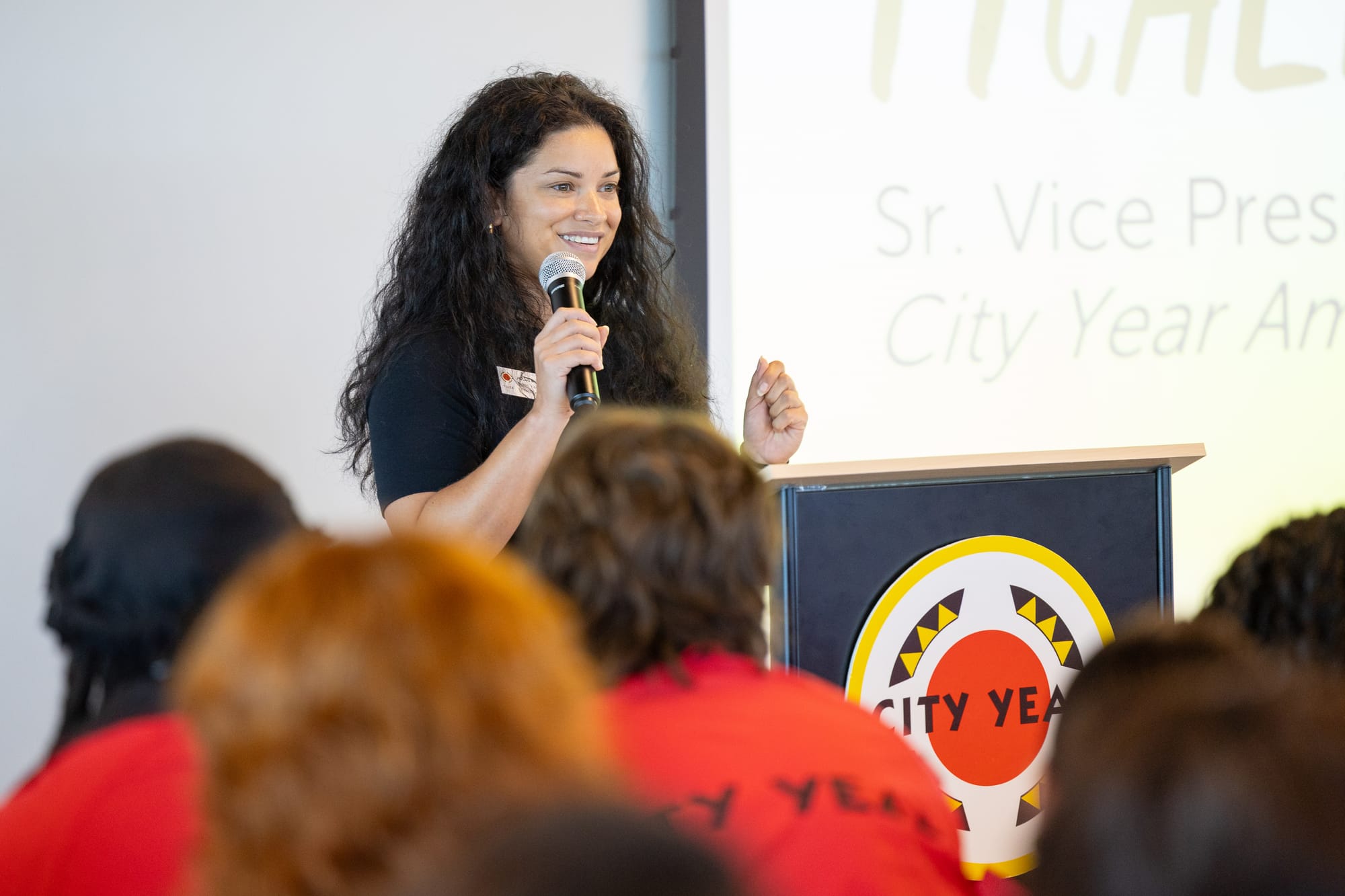
Hollis McAllister’s mic-drop moment came near the end of a recent conversation when she said, “I believe the world needs more idealists, and there’s no better way to grow idealism than through national service.” Those two themes, idealism and service, are the foundation of McAllister’s personal and professional ethos. Wait, there’s a third: community. Well chosen, wouldn’t you say? They’re essentially the mirepoix for creating happy, healthy people, schools and communities.
McAllister, fittingly, is the senior vice president and executive director for City Year Tulsa. Founded in Boston in 1988, City Year is a brilliant educational nonprofit and AmeriCorps program operating in 29 cities across 21 states. Its goal is to help elementary and high school students improve academically, stay in school and graduate on time. To support that goal, City Year recruits AmeriCorps members, aged 17-25, who commit to serve as student-success coaches, working in schools 50 hours a week for a period of 10 months. It’s a win-win.
“City Year really has a double bottom line: We are focused on providing a coach for every student and a path for every young person. What that looks like in practice is we recruit 17- to 25-year-olds to serve as near peer tutors, mentors and role models,” McAllister says. The young adults support students with their attendance, behavior and course performance, while also taking important steps in their own journeys. “Whether they’re coming to us right out of high school or after undergrad or somewhere in between, we really take that role seriously of helping them figure out what that next path is for them.”
McAllister believes in addressing the challenge of disconnectedness, creating spaces of belonging, and in the power of showing up. She knows that City Year offers a safe place for people to try new things, test themselves and grow. It did that for her father, after all. “City Year has actually been in my life since 1993 or 1994. My dad served as the facilities guy for City Year’s headquarters in Boston and ended up having a 27-year career at City Year,” she says. By the time he left the organization, he’d risen through the ranks and was vice president of employee relations. “As a kid, I was able to see my dad really be seen by his employer and invest and trust him to climb the ladder. To see my dad go from being the guy with the key to the facilities closet to a vice president was really inspiring.”
Young Hollis also felt the sanctuary of City Year personally. In her hometown—Acton, Massachusetts, a town about 20 miles from Boston—she says, “I grew up in a community that didn’t necessarily reflect my identity as a biracial kid learning about herself.” Except, she said, when she tagged along to work with her dad. “City Year was always a place that was just full of people from all sorts of different backgrounds, walks of life and ideologies, and so if school was out, I was begging my dad to let me go to City Year offices with him, just because I could tell that there was something really different about how people were in community there.”
The lack of representation at school affected McAllister’s confidence and grade point average. “I felt like when my classmates would learn that I’m biracial, it would invite questions that, as a kid, I wasn’t really equipped to handle, and certainly my peers didn’t know how to talk about different identities,” she says. She decided her best strategy was to “just stay quiet, don’t invite attention, just mind your own business.” She got a D in a class during her sophomore year in high school. “My dad said ‘Delightful,’ and then he said, ‘If this is truly the best you can do, then I’m okay with this, and I’m still proud of you.’” Heart-wrenching, she said, but also unconditionally loving. It was her one and only D.
City Year Tulsa graduation 2026
Another pivotal moment in McAllister’s academic career arrived in the form of a school counselor named Aisha Brown. “She came to my school my junior year of high school and was the first adult woman of color that ever worked in any of my schools growing up.” Brown brought with her the exact brand of tough love McAllister needed. “She was the first person to really call me on where I was headed. Acton-Boxborough is one of Massachusetts’ highest performing high schools,” McAllister says, admitting that she felt like going to AB, as it’s known colloquially, was enough to get her into her top-choice college. Brown would have none of it, saying, “You want to go to UMass Amherst? You’re not going with these grades.” Nobody had ever really laid it out like that for McAllister, who got her ducks in a row and did get into UMass Amherst. “I’m so very grateful for Aisha Brown,” she says. In a sweet, full-circle moment, Brown wrote McAllister’s college letter of recommendation.
In college, McAllister initially thought she wanted to become a school counselor as well and declared herself a psychology major. A required behavioral neuroendocrinology class changed her mind, and her major. Communications for the win! “I saw friends that were taking comms classes and was like, ‘That sounds like so much fun!’” After graduating from college, she knew she wanted to work at City Year. “I did not tell my dad that I was applying to serve with City Year Boston until after I had accepted the role,” she says.
She spent the next two years in a fourth-grade class, where she learned an important lesson: the power of showing up. One day, a music teacher, Mrs. Foster, stopped her in the hall and said, “I just want you to know how much I look forward to seeing your smile in the hallway when I’m having a bad day, because I always know that you’re a positive influence for me and for these kids.”
She also learned from her students, including one little boy who kept not doing his homework. Exasperated, McAllister finally said, “Dude, what’s going on?” Eventually he shared that he was staying with his grandma. “He wasn’t sure when his mom was going to come back, and his grandma didn’t have any pencils, and nobody at school knew that this is what was going on,” she says. No pencil is both a tiny and a huge barrier for a little boy.
After her two-year stint, McAllister knew she wanted a career at City Year. She’d found her place in the universe. “Somebody asked if I was afraid to leave Boston,” she says. “The answer was yes, and that was when I realized what my relationship with fear is, because the second that I named that I was afraid, I was like, ‘Okay, well, I’m applying.’” There was a startup City Year in Tulsa. “I had no idea where Tulsa was. Two weeks later, I was moving to Tulsa to be the operations manager.” She moved up to the chief of staff position, then briefly worked for City Year’s national headquarters, leading a continuous improvement program. “Then I came back to work for the Tulsa site, where my heart is, and last November had the opportunity to step into the interim executive director role, and in January officially became the executive director, the first woman executive director of City Year Tulsa.”
There’s never been a greater need for initiatives like City Year. “We know that young kids, young students, need more academic support. The data shows that that’s the case in public education in Oklahoma, and in addition to that, they really need spaces of belonging and adults who know their names, know their strengths and are going to be by their side to celebrate their successes.” •
The Luxiere List
City Year Tulsa
Since Inception:
City Year Tulsa has served 58,870 students through City Year-led Whole School events and initiatives, and 16,753 students through individualized support.
Tulsa students who received individualized support from City Year were almost twice as likely to reach the 10th grade as their peers.
Tulsa students who received individualized support from City Year for multiple years graduate at significantly higher rates than their peers—15% higher for one year served, 37% higher for two or more years served.
In 2025 and 2026:
There were 75 AmeriCorps members in service at City Year Tulsa.
Seven Tulsa schools partner with City Year teams.
2.45 million minutes of support were provided to students through initiatives and interventions.
4,795 students were served through whole school initiatives.
2,011 students received individualized support.
Key partners include Bank of Oklahoma, Charles and Lynn Schusterman Family Philanthropies, George Kaiser Family Foundation, QuikTrip and the Tulsa Area United Way.
The link has been copied!
Your link has expired. Please request a new one.
Your link has expired. Please request a new one.
Your link has expired. Please request a new one.
Great! You've successfully signed up.
Great! You've successfully signed up.
Welcome back! You've successfully signed in.
Success! You now have access to additional content.