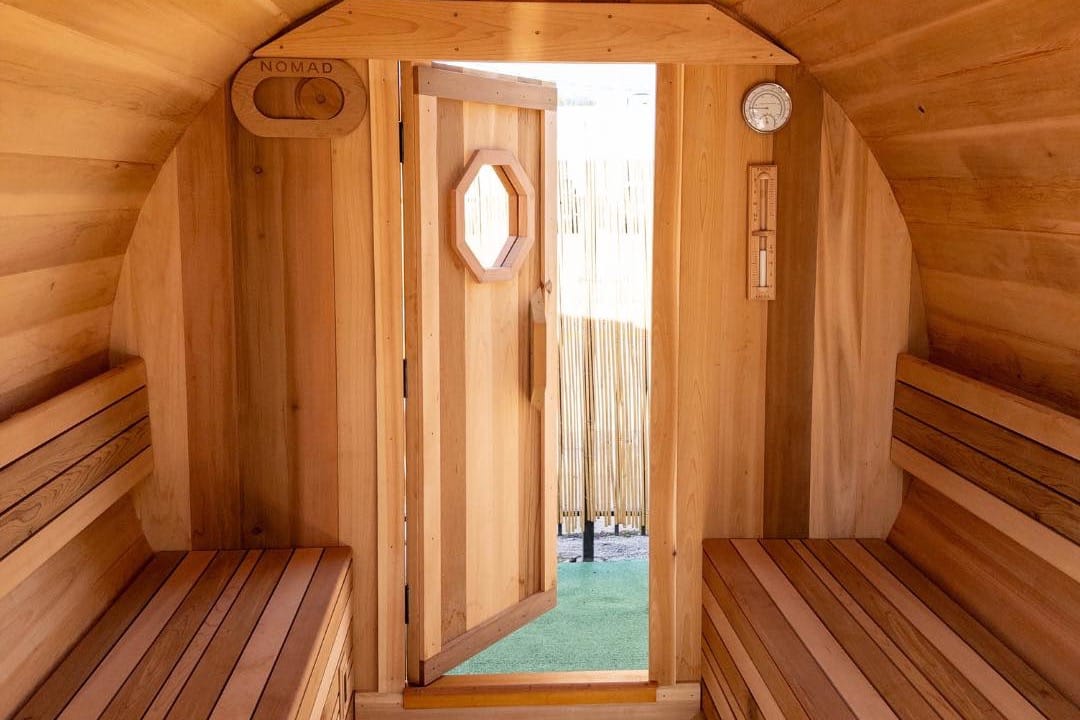
It seems like everywhere you look, there’s a new way to sample sauna socializing in Tulsa: Wolf Mother, an industrial warehouse refabricated into a communal bathhouse in the Kendall-Whittier neighborhood; saunas, hot tubs and cold plunges at Recover in Utica Square; infrared saunas tucked into boutique gyms around town. Sauna culture is booming in the U.S. again, after seemingly falling out of fashion in the 20th century—a casualty of indoor plumbing and an American squeamishness around the idea of a group sweat. Its resurgence owes something to a wellness industry rediscovering the basics, and something to a growing appetite for social rituals that don’t depend on alcohol as their animating factor.
Because that distinction matters. It’s one thing to sit alone in a hot tub and unwind; it’s quite another to sit shoulder to shoulder in a sauna, quietly catching up with a friend or new acquaintance, beads of sweat pooling alongside the two of you like passed conversation. One offers psychic escape, the other presence and connection—the exact conditions sauna and bathhouse cultures were meant to create.
Several years of testing the waters of bathing culture—both as a curious observer and an enthusiastic participant—eventually found me soaking in New York City, where a fondness for bathhouses solidified into something closer to devotion. New York offers a broad, ever-nichifying spectrum to sample: the authentic Russian & Turkish Baths on 10th Street; the Korean spas of New Jersey; and newer arrivals like Othership. The latter quickly amassed a sauna-capped cultlike following for its guided sauna and ice bath experiences, which are explicitly designed to help guests “regulate your nervous system, process emotions and connect meaningfully with other human beings.” Sauna has seeped so deeply into the social fabric of NYC that Brooklyn’s Domino Park transformed into an experiential sauna festival for the entire month of February, comprised of 15 saunas, cold plunges, sound baths, in-sauna hand puppet shows and nightly Aufguss ceremonies led by global sauna masters. At its worst, it felt like an overrun music festival, hundreds of sweaty bodies jostling for a seat before the next Aufguss ceremony hit capacity. At its best, it felt like a total breath of fresh—if thick and hot—air.
The Baltic Sea stretches out at golden hour
Like so many other fanatics, I’ve built entire trips around the ancient practice of social bathing. In Ojo Caliente, New Mexico—the name meaning “hot eye” as in a warm pool of water—the mineral-rich thermal springs have always felt like a home away from home, perfect for solo healing trips, vision quests and reckonings with oneself. On a trip to upstate New York, a wood-burning sauna beside a cold trout stream offered a lush autumn respite before returning to the chaos of real life. But nowhere have the history, tradition and camaraderie of sauna culture felt more vivid than on a recent pilgrimage with friends to Helsinki, Finland.
In the U.S., a sauna is a welcome upgrade at the gym, but in Finnish culture, it’s a daily ritual; as commonplace as a morning coffee, an after-work happy hour or even a quick business meeting. For centuries, the sauna (pronounced sow-na) has been the venue for everything from socializing to childbirth. Despite its ancient roots, Finland is considered by many to be the birthplace of modern sauna culture. Two thousand years ago, smoke saunas—known as savusaunas—were heated by building fires beneath piles of stones. Water poured over the hot stones produced löyly: the dense, enveloping steam that gives a sauna its signature heat and sweat. Today, the heat still comes from coals, but also from wood-burning stoves, or even infrared lights—as seen in that $2,000 Costco sauna reel making the rounds on social media.
Our trip ritual went something like this: 15 minutes of sweat with talk, 10 minutes of sweat in silence, and then a however-many-minutes-you-could-stand-it plunge into the frigid waters of the Baltic Sea. Hot tea to warm back up, water to cool back down, local fare and natural wine in the evenings, recounting the revelations that found each of us in the steam.
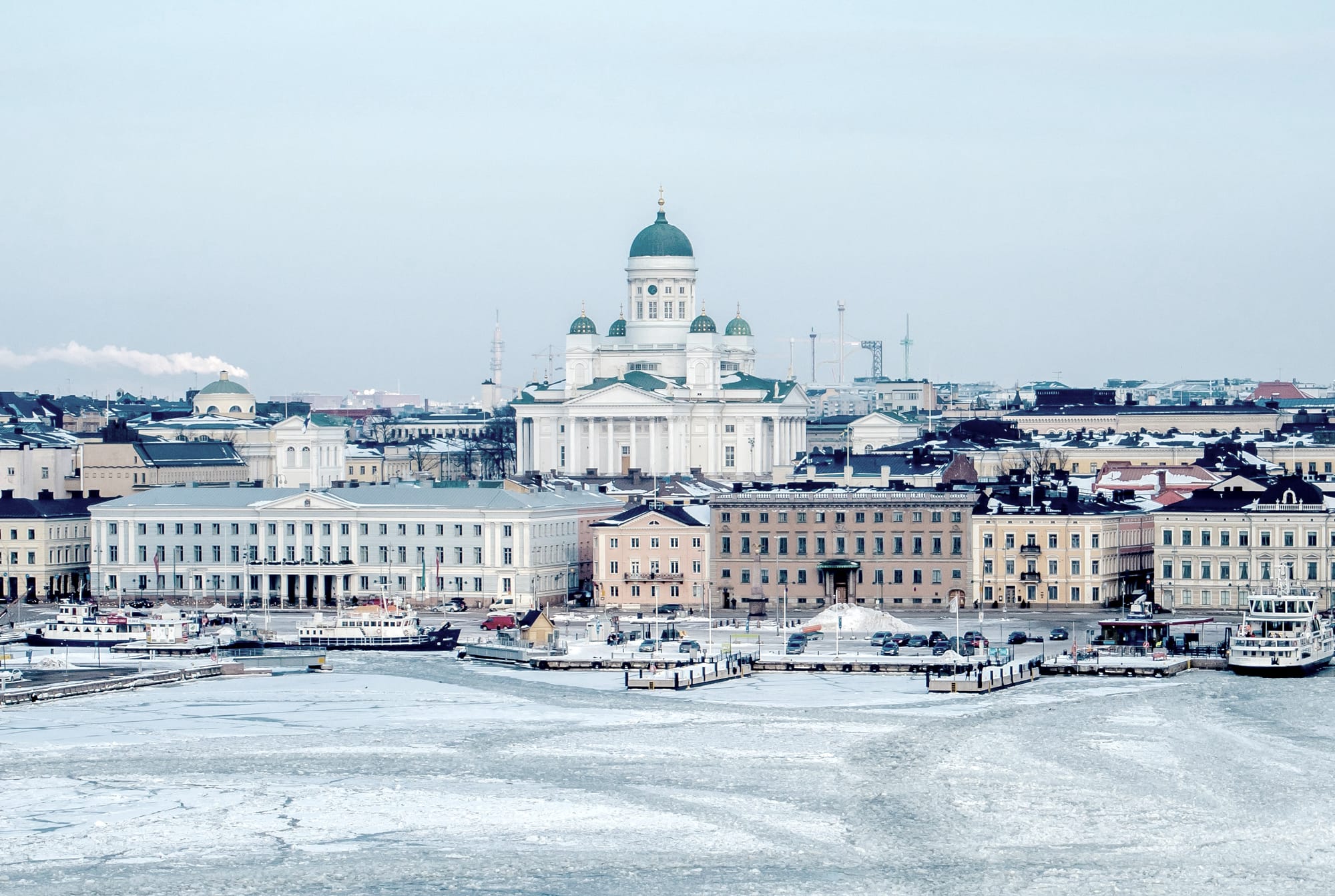
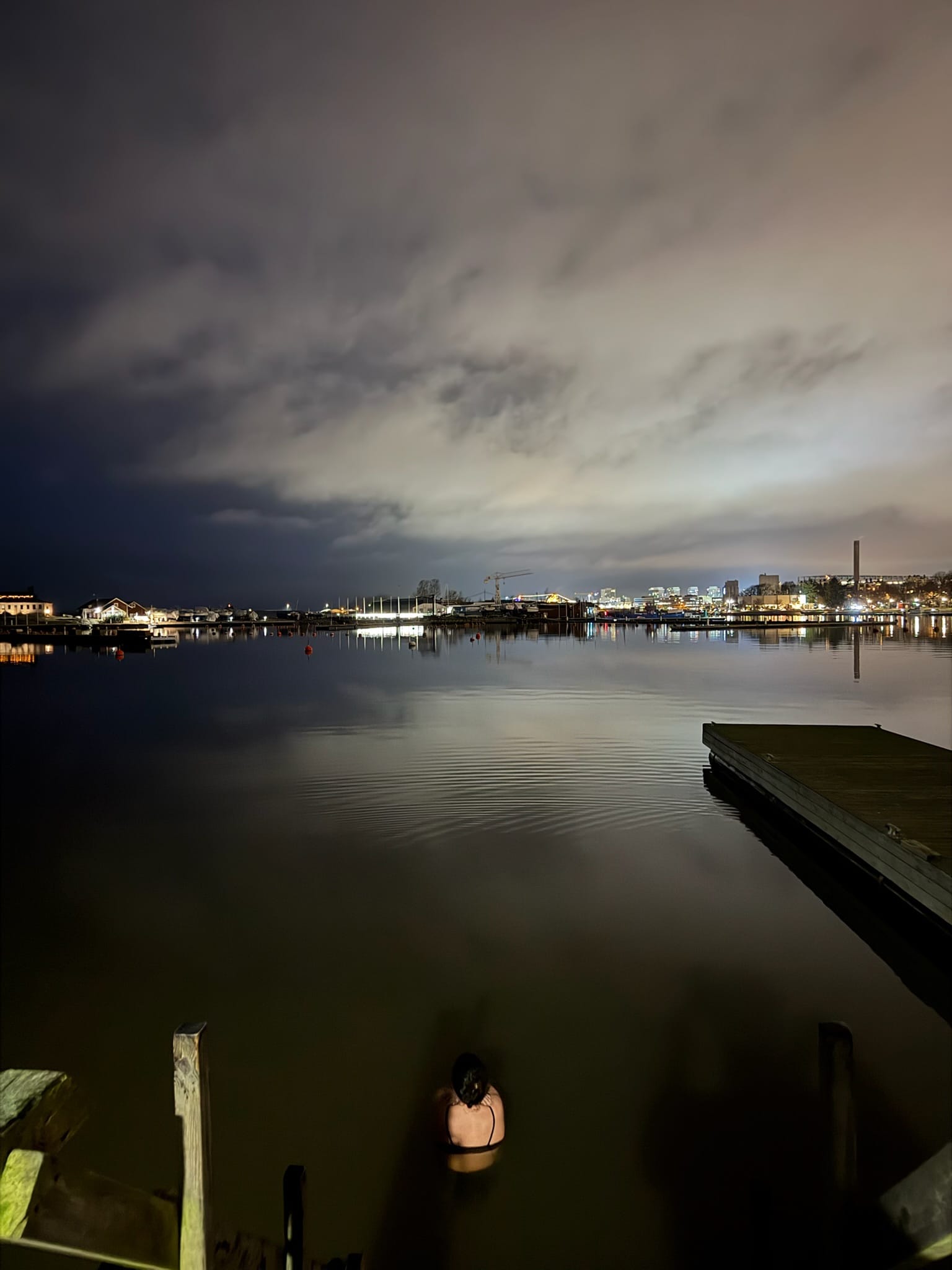
LEFT: Helsinki Cathedral towers over a frozen harbor. RIGHT: Cold plunge at Uuni Saari
In Helsinki, public saunas are ubiquitous, but each has its own tone, style and scene. At Löyly, the Baltic stretches out at golden hour—still, silver, vast. Inside, the heat is dense and birch-scented; outside, the cold hits the chest like a wall. The contrast is visceral, almost disorienting. It feels like being on the edge of the world.
Inside Löyly, day-pass guests move between communal smoke saunas and wood-burning rooms, the light seeming to set the mood of each: Brighter saunas hum with multilingual chatter and easy laughter, while the dimmer ones simmer in near-silence, like water on coals. Outside, wind cuts across the sea, broken occasionally by the yelp of someone discovering, for the first time, just how cold cold water can be. On the other side of the building, a Nordic restaurant with sweeping sea views offers a heartier kind of restoration: salmon soup, and the particular relief of sitting down after a long sweat.
If Löyly was our most romantic Finnish sauna experience, Uuni Saari was our most rustic. What it lacks in drama, it makes up for in stillness, and the feeling that you’ve stumbled into one of the city’s most quiet corners. A loose cluster of wood-burning saunas connected by a rock path spills out onto a public sandbar beach, where a wooden dock and steps lead down into the freezing sea. Nearby, an empty boat slip hints at a livelier scene in summer. But in December, there’s nothing here but cold air, still water and the particular peace of somewhere that isn’t trying to be anything more than what it naturally is.
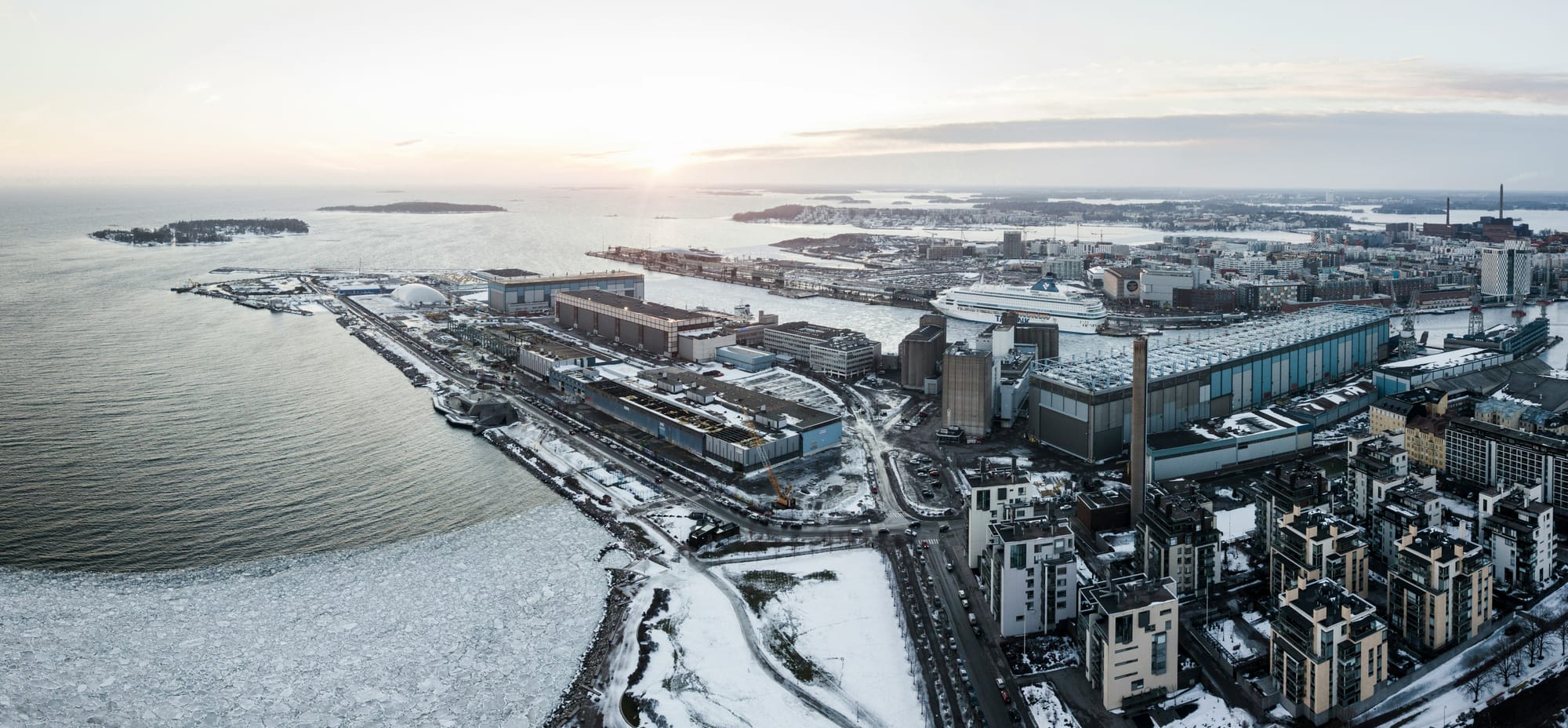
The Finns aren’t picky about their sauna schedules, and it’s as common to sweat in the morning as in the evening. So we began one of our days in the city with an early visit to Allas Pool, a seaside oasis in a harbor just off the city center. Allas has five saunas ranging from 70–90° C, including a panoramic sauna with sweeping harbor views, a heated pool kept at 27° C for year-round swimming and a seawater pool that hovers around freezing—the most bracingly authentic cold plunge in the city’s industrial district.
Sauna at Wolf Mother in the Kendall-Whittier Neighborhood, Tulsa
The seawater pool comes equipped with hanging ropes and grab bars along the sides to help swimmers stay submerged. A good goal for beginners: shoulders under and hold for 30 seconds, or until the initial shock passes and breathing steadies … which is, allegedly, when the benefits of cold exposure begin. Neurobiologist Andrew Huberman recommends at least 11 minutes of cold exposure per week; in Helsinki, the promise of a hot sauna on either side makes that target feel almost alluring, as well as achievable.
After our morning sauna and plunge session, we warmed up with coffees before setting out through the city past art nouveau facades and historic cobblestones, the pastel pinks and yellows of turn-of-the-century Helsinki bright against a grey winter sky. We wound down the evening with lohikeitto, more of Finland’s famous, creamy salmon soup, and reindeer steaks that tasted exactly as you’d hope they would this far north.
The streets of Helsinki feel clean, bright, and unhurried—a different kind of immersion from the sauna, but not unrelated. There’s something in the pace of the city that mirrors the ritual: Slow down, be present, let the heat (or the cold, or the quiet) do its work. In Helsinki, you’re never far from your next sauna. And back in Tulsa, if the steam rising from Kendall-Whittier is any indication, neither are we. •
The link has been copied!
Your link has expired. Please request a new one.
Your link has expired. Please request a new one.
Your link has expired. Please request a new one.
Great! You've successfully signed up.
Great! You've successfully signed up.
Welcome back! You've successfully signed in.
Success! You now have access to additional content.