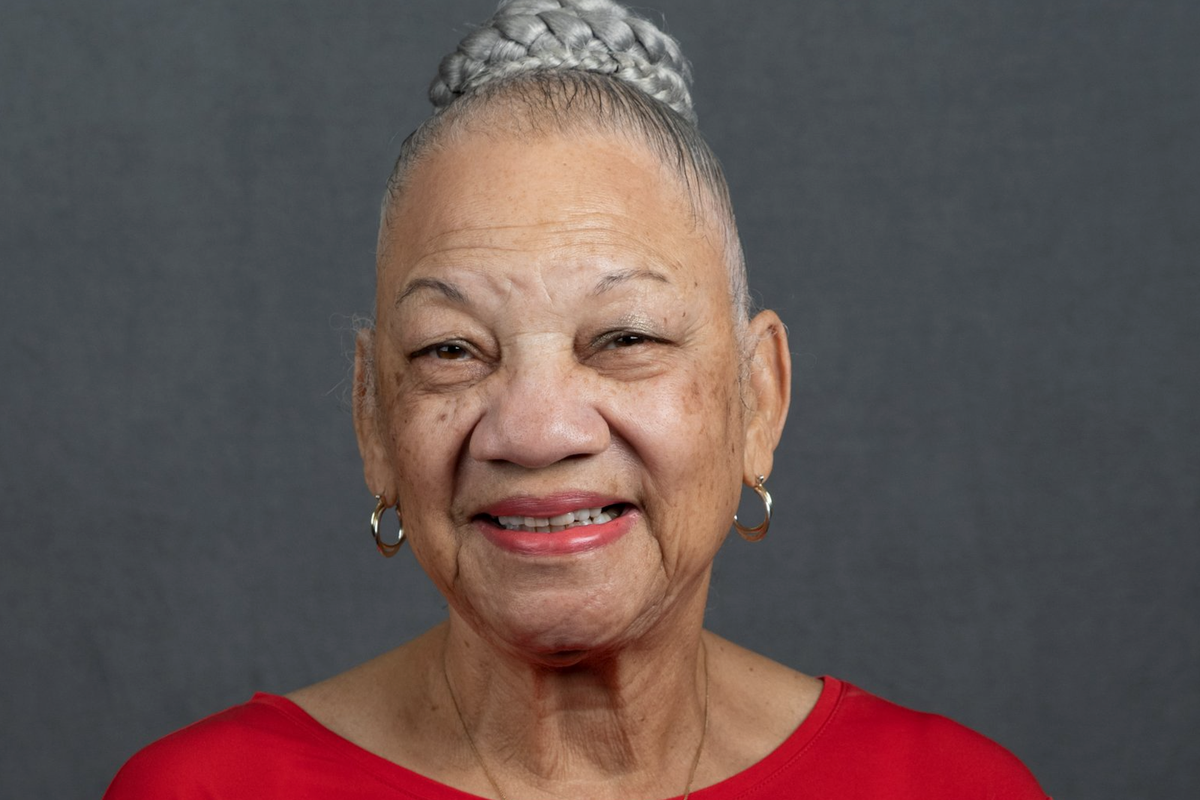
Anita Golden Arnold is an extraordinarily accomplished woman with a powerful intellect. She’s naturally curious, an avid reader and a devoted globe-trotter. Witty. Self-effacing. A great conversationalist. She’s also a cool person, something everyone wants to be, but few truly are. It’s in the way she approaches life decisions, the way she shares a story and the way she gets things done. Arnold’s stories often begin with a little laugh, followed by “I was minding my own business, when …”
For more than 30 years, Arnold has served as executive director for Black Liberated Arts Center, known colloquially as BLAC, Inc. “Our mission is to educate young people, especially. Everybody, particularly young people, in history and in arts,” she says.
How she became executive director is classic Anita Arnold. Years before, she’d made a financial contribution to BLAC, Inc. “I was doing my taxes, and I was going to owe,” she says. It wasn’t just a little. “I knew I would rather give it away.” She called a friend who suggested BLAC, Inc., and Arnold sent a check.
She’d also served on its board of directors. “I was leaving the board when other things opened up. The board asked if I’d serve as executive director,” she says. This was in the mid-1980s, when Arnold had taken early retirement after an impressive corporate career. The previous director, who’d been with BLAC, Inc. for 20 years, had resigned, and the nonprofit was on shaky financial ground. “There was no money. I started to get us on steady footing.”
Arnold was told at a conference in Austin that if a nonprofit wasn’t working like a business, it would soon be extinct. “I used my business experience and systems thinking. I knew that most things that don’t work in Oklahoma City don’t work because people don’t know ‘how to.’ When you do know how to, things will work.” Her corporate acumen, developed over decades, continues to serve her organization extraordinarily well.
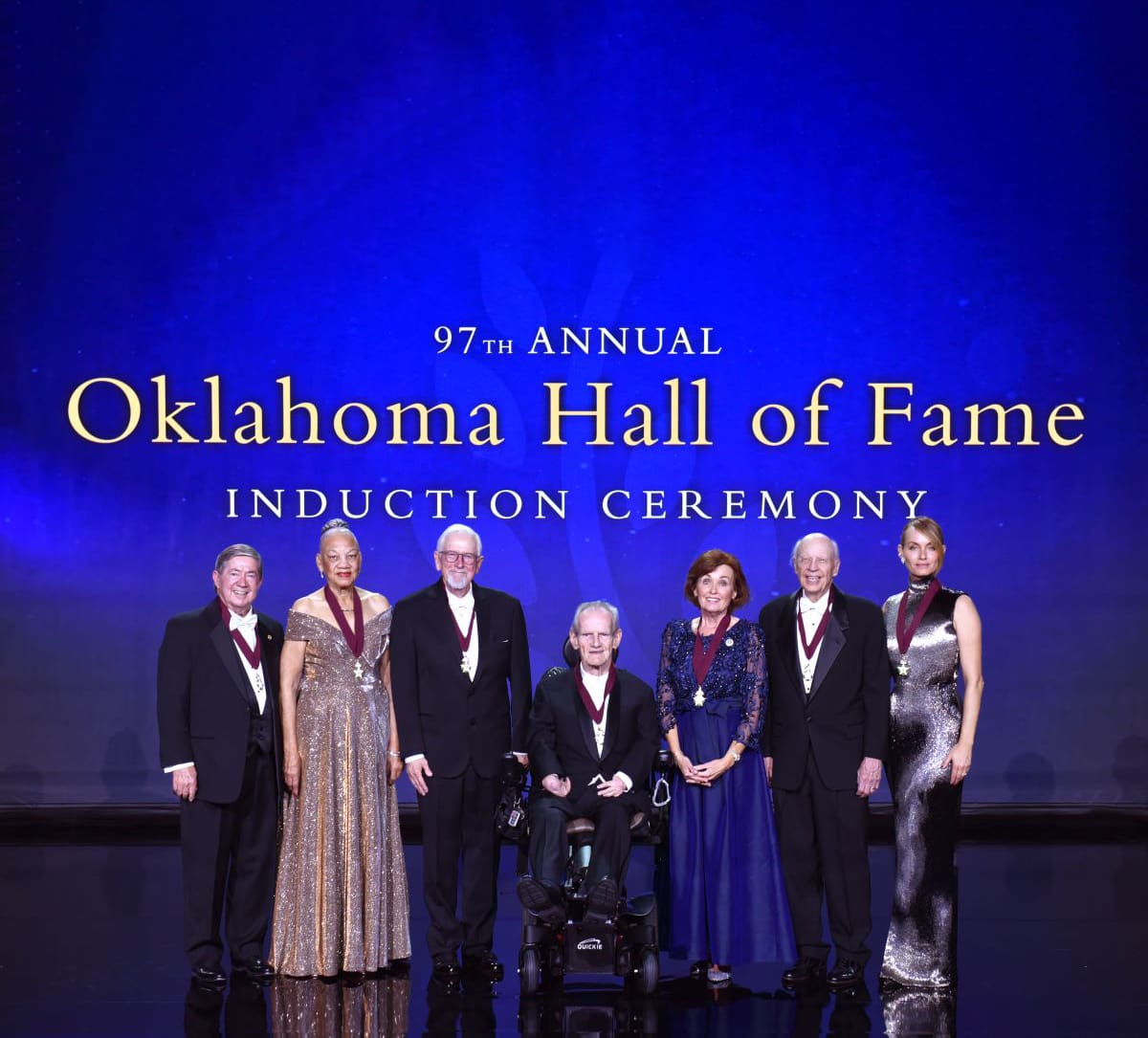
Anita Golden Arnold stands among her fellow Class of 2024 inductees at the 97th Annual Oklahoma Hall of Fame Induction Ceremony
As a Black woman navigating and climbing the corporate ladder in the mid-to-late 20th century, Arnold experienced coded and overt racism. When she was hired at Western Electric, Arnold—who had studied math, engineering and computer science—was offered a position she was clearly overqualified for, on the assembly line. At the time, the company was well known for not hiring Black people. But she was talented and beyond qualified. “I was hired with an apology. They knew I was qualified for much more than their offer,” she says.
Illness kept her home on her first official day of work, and she went to see her doctor. She needed a note verifying that she was ill, and when she said she worked at Western Electric, wheels in the Black community quickly started to turn. “The Urban League had been trying to break the door open there,” Arnold says. She found the job frustrating but, encouraged by the head of the Urban League, she stuck with it and was eventually promoted to a role in computer support.
“I had a couple of careers with what is now AT&T. I started at Western Electric in Oklahoma City in 1960. It was my first venture into the corporate world, and I was there for nine years,” she says. While there, Arnold completed her education via the company’s tuition program, earning a bachelor’s in production management with a double major in math and computer science from Memphis State University, summa cum laude. For many years she was the only person of color and the only woman in her classes and work assignments.
“It was always just me, the lonely woman of color. It was almost like being the invisible person. The guys would all sit around and have a conversation. I listened and occasionally said, ‘That isn’t going to work.’ But they’d ignore me and sure enough, it didn’t work,” she says. Eventually, the meeting dynamic shifted, and she was asked if she had anything to add. At one point her manager chastised her for being “so hard on the guys.” To which she replied, “Well, that’s who’s in the room.”
About her first departure from the company, Arnold simply says, “I got sick of the racism.” It wasn’t the only job she left for that reason. She’s matter-of-fact about it, saying, “I’d always known that the higher your position the more likely you’ll encounter challenges. I’m always up to a challenge. The key is you’ve got to know yourself.”
Her career also included working for the national office of the U.S. Postal Service, in Washington, D.C. She began work at the Postal Service at the highest level for any woman of color in the United States. In the span of two years, she was promoted to program manager of the real estate and buildings department, becoming the second highest ranking female in the United States Postal Service.
Her corporate career took her around the country and around the world—five of the seven continents. She’s met presidents and kings. She has a group of traveling buddies whose motto is “have bags, will travel.” “I once went to China for 17 days, with $200 in my pocket,” she says. “It was through the Citizen Ambassador Program. If you ask me how I was invited, I don’t know, but I was, so I hustled up the money and went.”
She brought arts integration to Oklahoma with the John F. Kennedy Center’s Partners in Education program, elevating outcomes of schools from the state’s low-performing list. She was first to bring the Smithsonian Institution to Oklahoma City with the 100th anniversary of Duke Ellington exhibit. She served a three-year term on the advisory committee for The Kennedy Center, where she’s been recognized for her service.
Born and raised in Tecumseh, Arnold moved to Oklahoma City to attend Douglass High School, graduating in 1957. In 1984 she was appointed, by the chairman of the Democratic National Committee, to serve on the Democratic Site Selection Committee for the 1988 National Convention in Atlanta, the first and only Oklahoman to do so.
Her speaking engagements have included keynoting the International Conferences of Mayors and the National Urban League Conference. She has conducted numerous workshops locally and nationally. Arnold was a member of the Black Business Council and served on the National Finance Council of the Democratic National Committee. Arnold has met and dined with a gazillion luminaries including Robert Mugabe, Jimmy Carter, Bill Clinton and Nelson Mandela.
If she’s not on a real-life adventure, she travels by book. “In school I loved to read and I love it now,” she says. A student of history, and a lover of adventure, Arnold’s calculus for whether she will do something is straightforward and, frankly, bold: “If it won’t harm me, I’m likely to move forward.” The way she approaches decisions for BLAC, Inc. is similar. “If it looks like it’s for the good, I’ll say yes.”
About Black Liberated Arts Center
Black Liberated Arts Center, Incorporated (BLAC, Inc.) is a 501(c)3 nonprofit, founded in 1969. Each year, it offers Oklahomans a season of music, dance, theater and the Charlie Christian International Music Festival.
Inside the headquarters on Lincoln Boulevard, visitors are greeted by the Deep Deuce and Beyond exhibit, created by Ron Tarver. There’s also a room dedicated to the life and legacy of Christian, an extraordinary American swing and jazz guitarist.
The Center is home to a Black History Library, which is filled with books carefully selected to help visitors understand history. In a recent interview with Oklahoma City’s Channel 5, Arnold offered the reason behind the library: “Some folks say if you don’t know your history, you’re like a tree without roots, and you’ll die.”
The link has been copied!
Your link has expired. Please request a new one.
Your link has expired. Please request a new one.
Your link has expired. Please request a new one.
Great! You've successfully signed up.
Great! You've successfully signed up.
Welcome back! You've successfully signed in.
Success! You now have access to additional content.