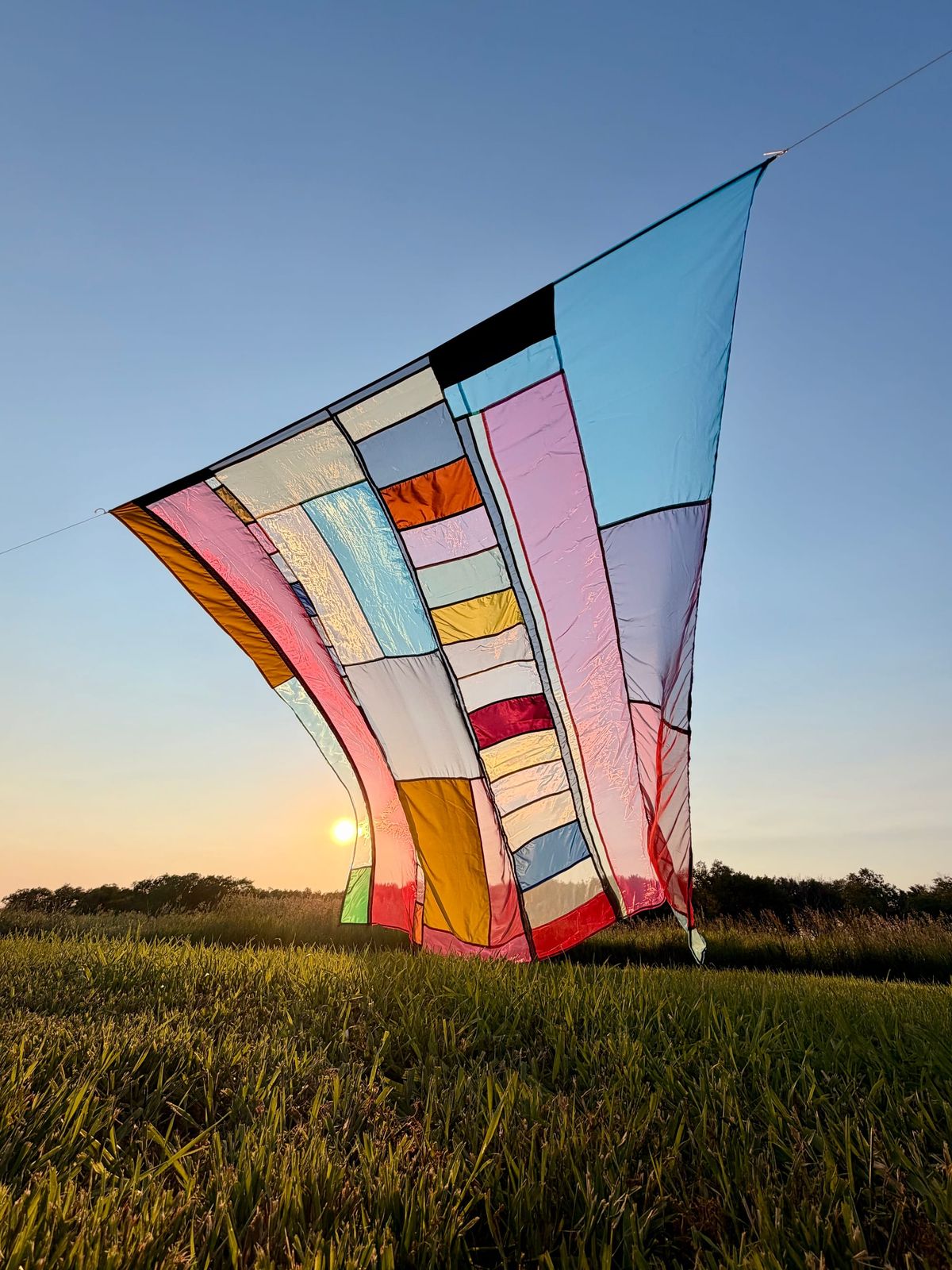
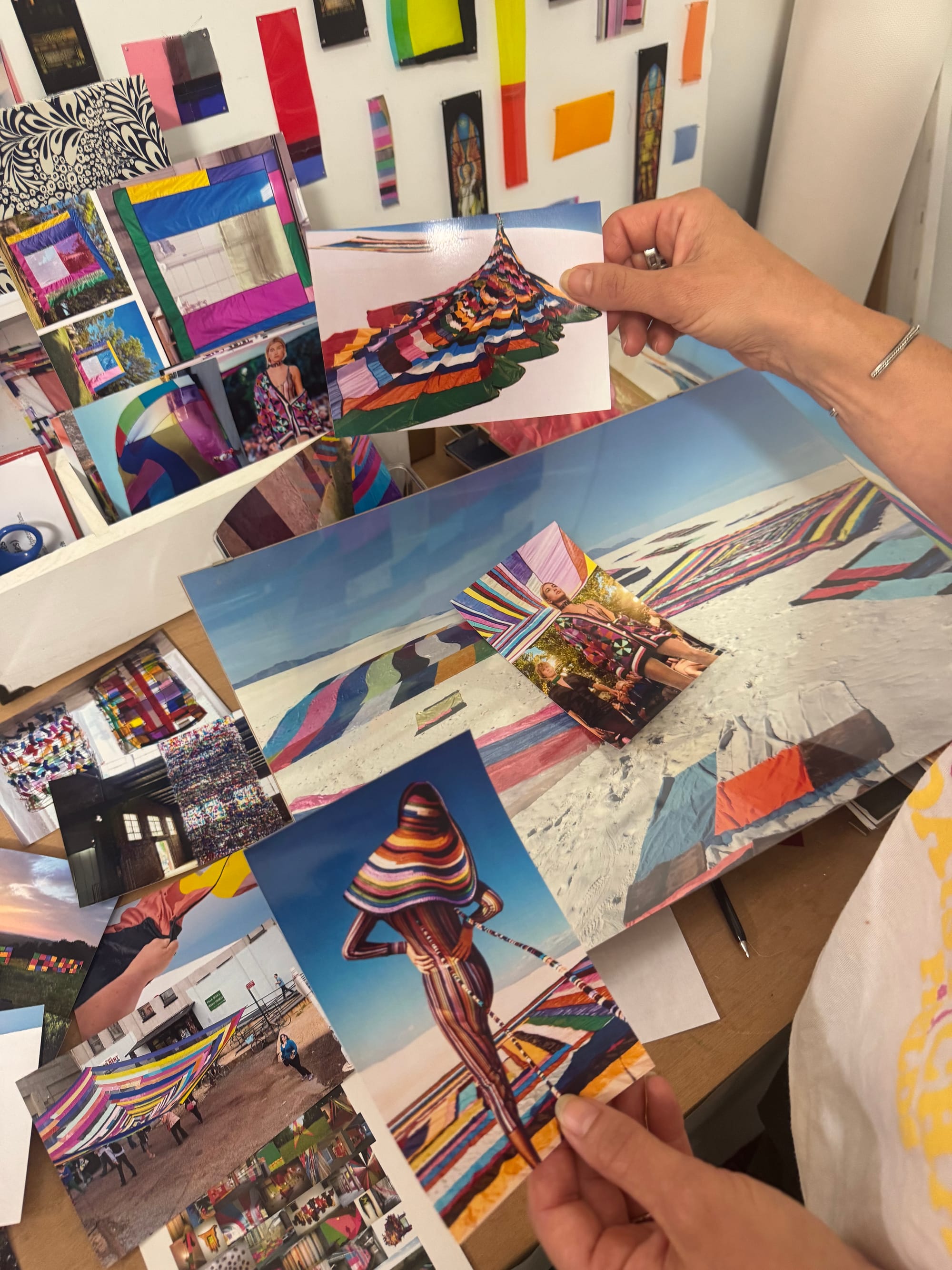
Standing inside her warehouse studio, flanked by handmade, floor-to-ceiling technicolor tapestries, Rachel Hayes embodies gentle power. In the center sits an agricultural hoop house draped in boldly colored fabrics. Across the room, a gigantic quilt has taken over the floor, eclipsing the commercial sewing machine that created it. Mobiles, photographs, garlands and pinwheels hang from the walls and ceiling; what’s left is claimed by stacks and racks of fabric.
I’m familiar with Hayes’ work, but seeing it all up close, I’m still shocked by the scale of it. She and I have become friends through our book club, where I’ll occasionally hear about her latest project or collaboration. But standing among the work now, I find myself doing the mental calculus of how we could possibly have the same number of hours in the day. It doesn’t compute.
Hayes is patient as I pepper her with questions. Soft-spoken, curious and full of wonder, she appears almost moony as she takes them in and considers them, standing across from me but gazing elsewhere—as if the answers were floating somewhere around us, moments away from arrival.
It makes sense; if her artistic practice has taught her anything, it’s how to wait for the break.
Hayes’ work is full of apparent contradictions: monumental but soft, architectural but porous, meticulously constructed yet ultimately surrendered to wind, light and landscape. Much of it begins with sewing, a practice historically dismissed as “women’s work.”
“Textiles and fabric already hold so much narrative,” Hayes says. “People can bring different things to the table, whether it’s, like, women’s work, fashion ... They can project onto it a lot of things.”
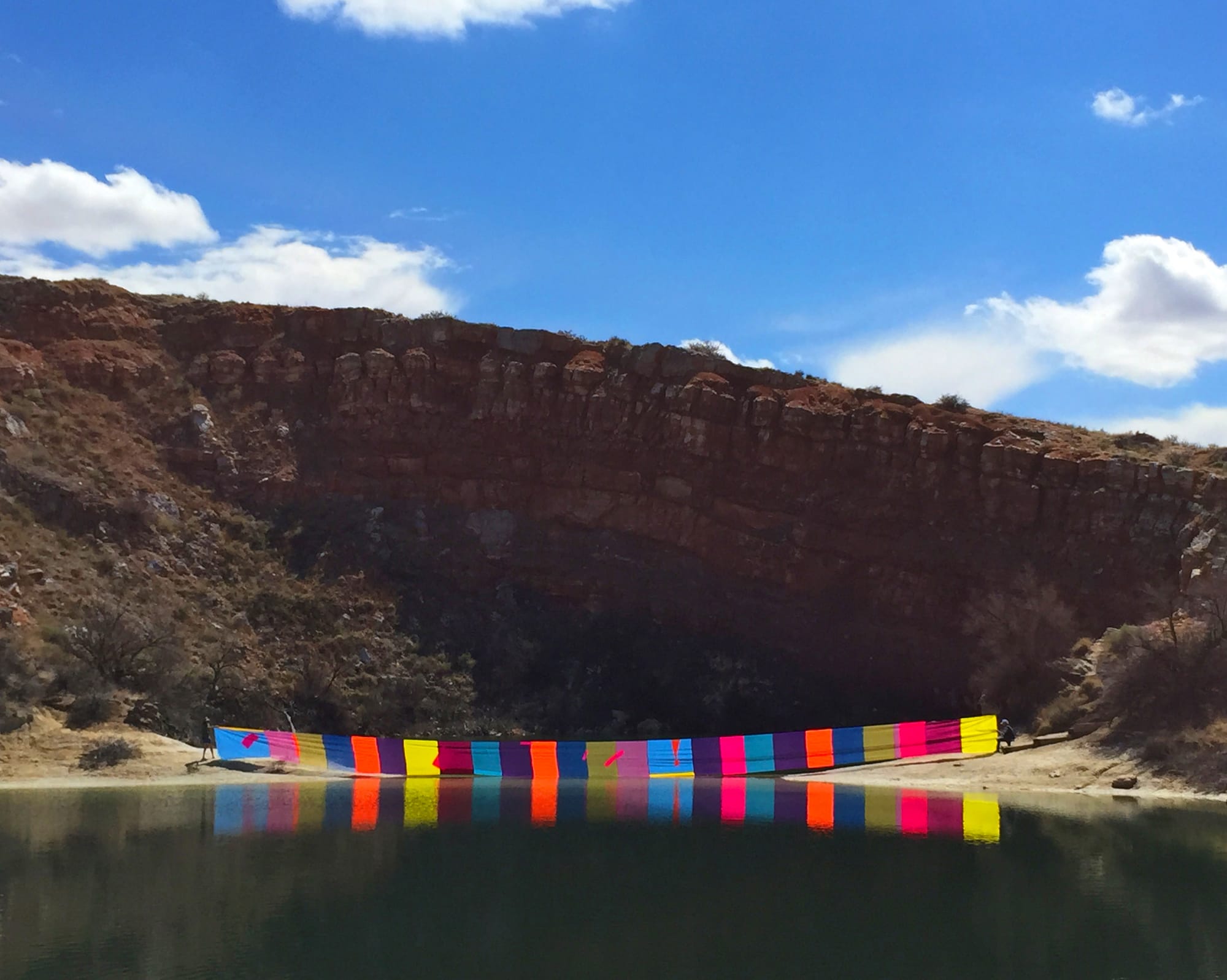
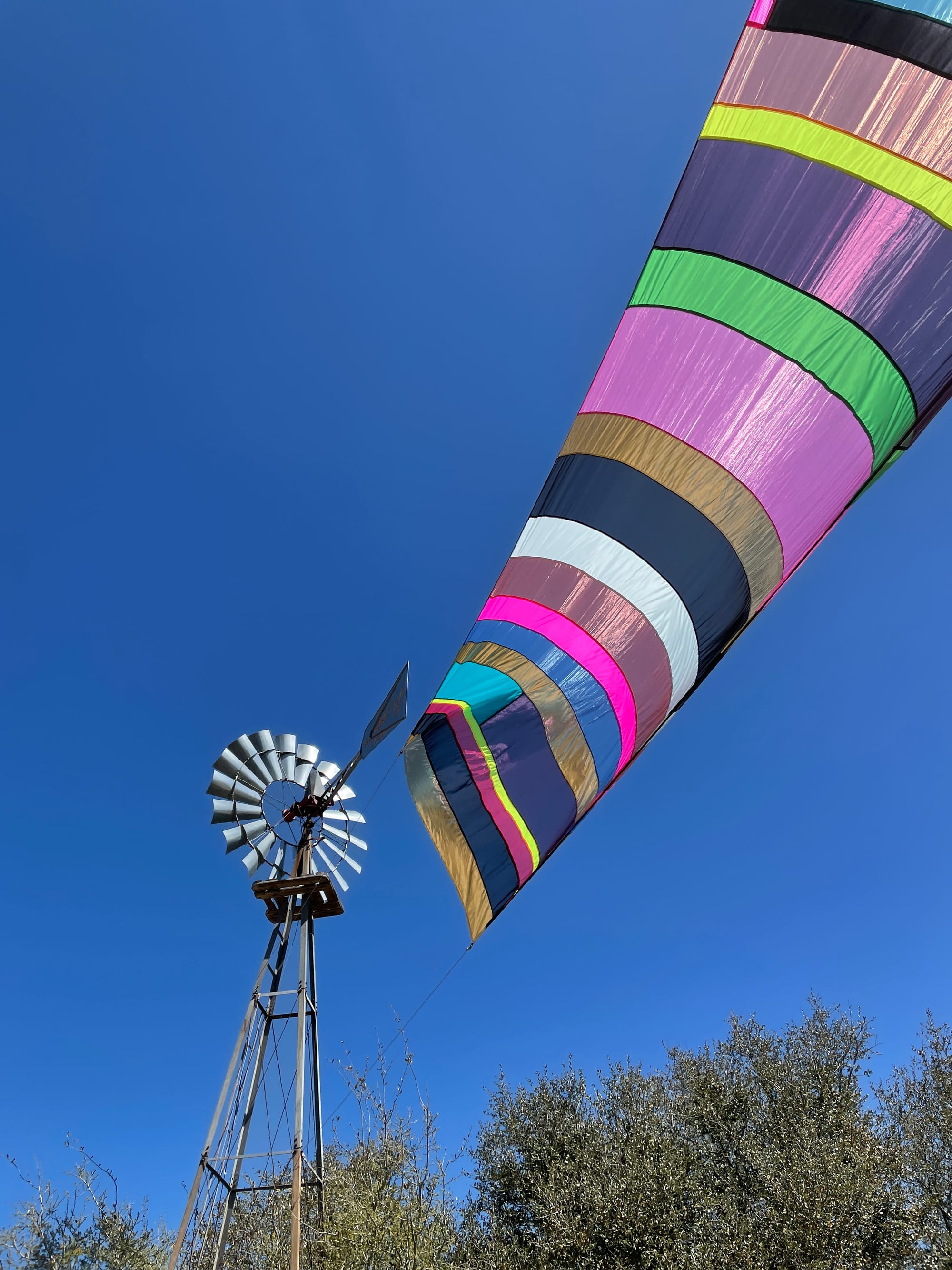
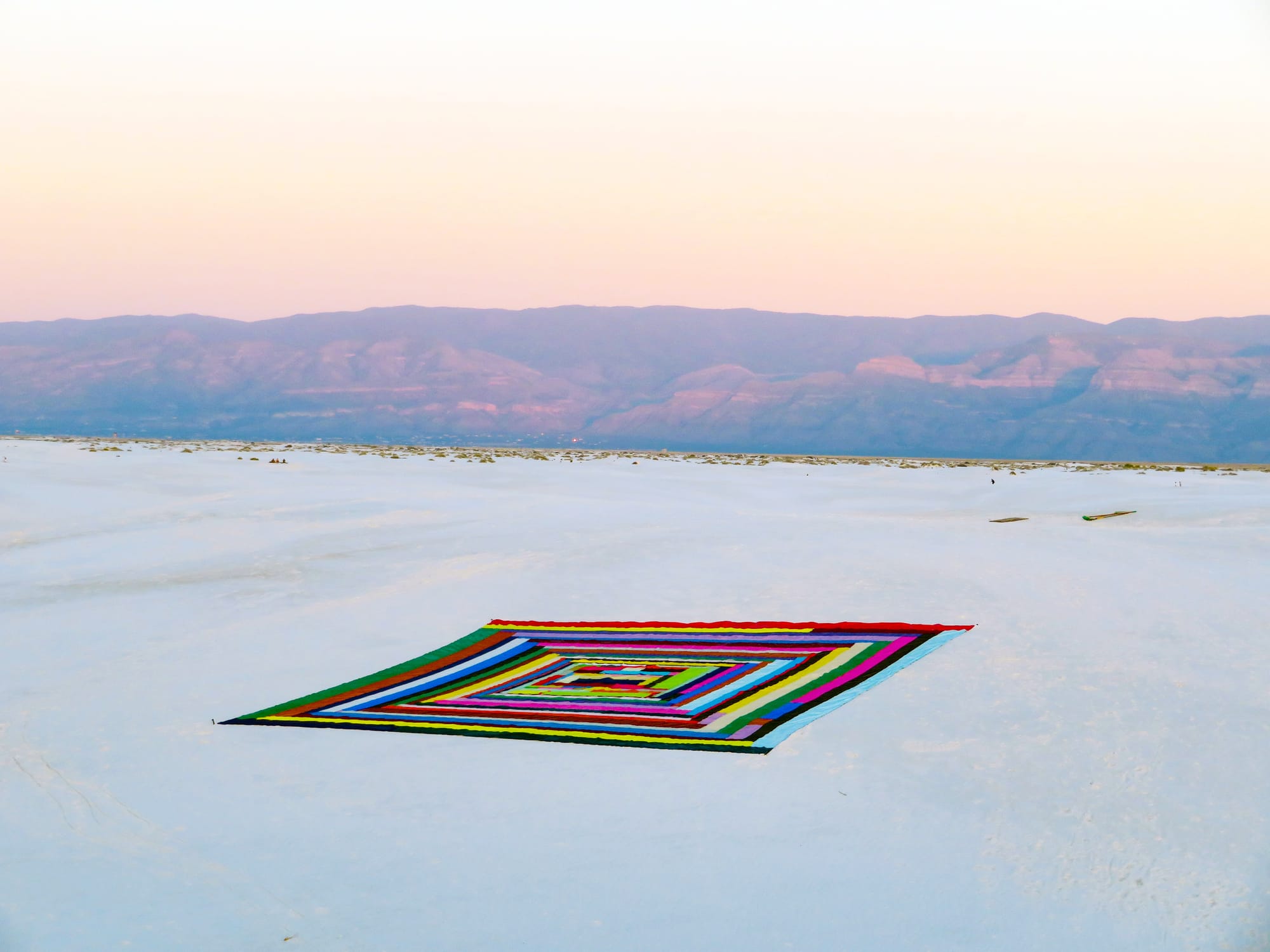
In Hayes’ hands, those materials become enormous: a tapestry stretched across the white sands of New Mexico; swagged panels suspended above a Missoni runway; hanging banners that form mazes; colorful fabric spilling from a Texas barn, visible for miles. Many of her installations are translucent, changing with the light, weather and landscape behind them. A 30-by-40-foot piece can feel monumental in Brooklyn and almost impossibly small against the desert. Rather than obscure the landscape, an installation becomes a veil to look through—a portal offering another view of it.
As an art student in the 1990s, Hayes found herself drawn to artists working in entirely different mediums, particularly the sculptor Richard Serra. But unlike Serra’s almost confrontational style, Hayes’ feels monumental without feeling menacing.
“I love the scale of his work,” she says. “I feel like I’ve been secretly competing with it. Like, ‘How can I do that? How can I make work that big?’”
Her version of monumentality had a different ambition: “I just wanted it to be about color and material, and to figure out how to make something the size of Richard Serra, but that wouldn’t make you feel like you’re gonna die.
“And I thought, ‘Maybe if I make something this big … no one will even care if it’s sewn anymore.’”
Collectively, her body of work feels like a meditation on what it means to be in relationship with the landscape. With wind whipping through the fabric, and light refracting at different moments, evolving to the changing slant of the sun, they take on a presence of their own—unpredictable, shifting and very much alive.
When I remark to Hayes that her works seem to dominate a landscape, but softly, she stops me. “Well, it actually doesn’t dominate,” she says. “It just affects.”
“Works with?” I offer.
And after a moment, her final assessment: “Responds to.”
Thumbing through photos of Hayes’ installations, I keep thinking about the enormous rainbow parachute that would appear on special days during elementary-school gym class: huge enough to engulf you, shapeshifting without being dizzying, thrilling, not threatening. Colorful, unpredictable, full of wonder.
I ask Hayes if she’s heard the comparison before. “Oh, yeah,” she says.
Twenty years ago, she might’ve bristled at it.
“But you can have very serious play,” she reasons. “As a kid, you’re seeing something kind of overtake you and overwhelm you, and you’re not threatened by it.”
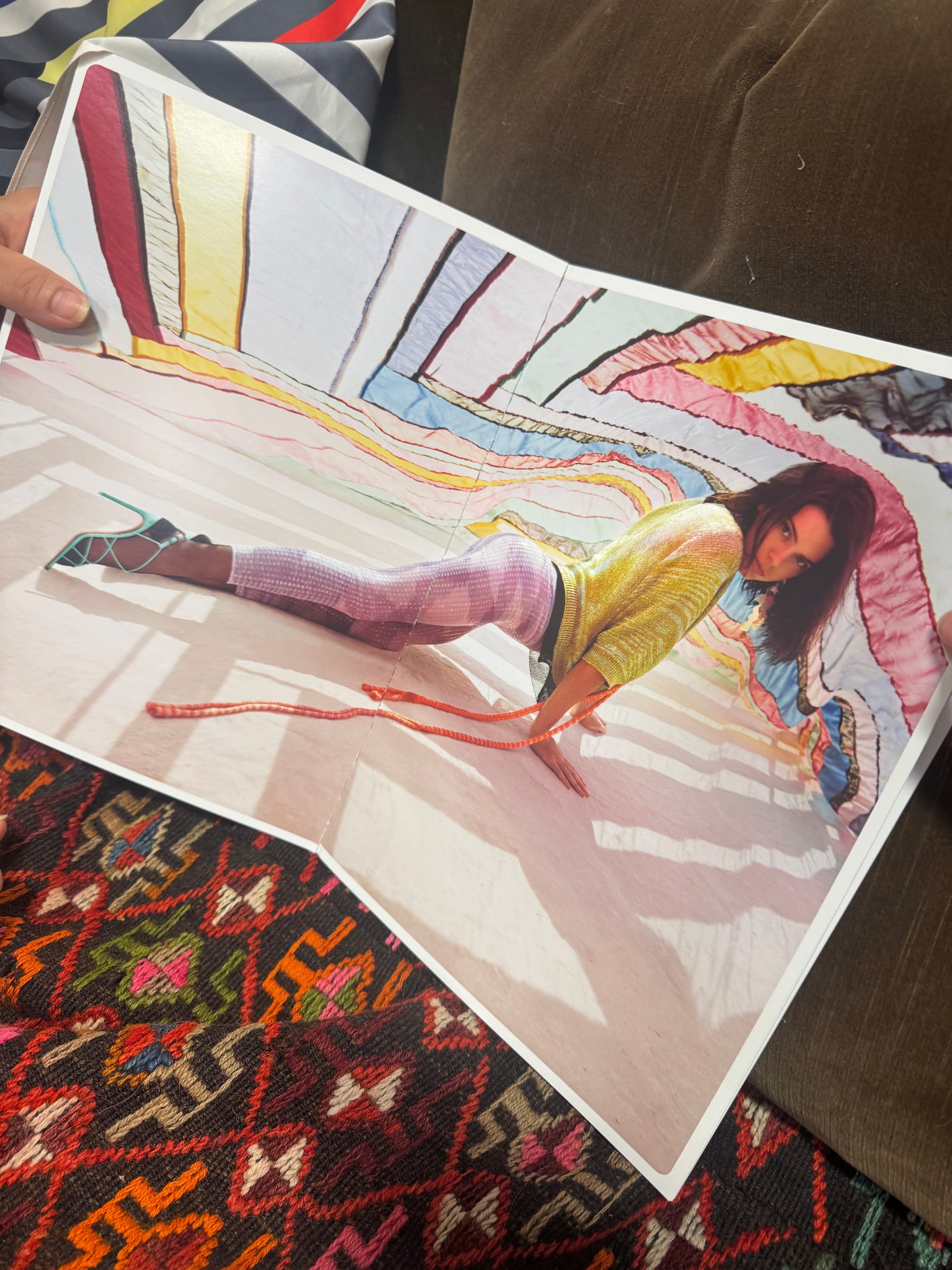
"Clouds Against the Clouds" shot with Kendall Jenner by Rachel Hayes"
In her work today, “serious play” seems to go something like this: Construct the thing. Put it into the world. Pay attention. Wait for the conditions to change, but be ready to capture the moment.
It’s a methodology that’s served her well, whether waiting for an award to come through, or waiting for the clouds to move across the horizon so she can get just the right shot.
“I’ve come through the back door, and waited for most things that I’ve done.”
Hayes’ experiments have carried her far beyond Oklahoma—from national parks and museum exhibitions to fashion shoots and a Missoni runway—but her work remains visible across her adopted home state. A hand-sewn tapestry once draped a Tulsa church like a technicolor god’s eye for months, and “City Jewel,” her new installation at Guthrie Green, will remain on view through November with the city skyline serving as its backdrop.
In August 2026, an email arrived from a producer asking if Hayes might be interested in showing work at a women’s arts event. Only after signing an NDA did she learn what it was: Olivia Rodrigo’s inaugural Daisy Chain festival.
Something of a Lilith Fair reincarnation, the festival featured a knockout, all-women lineup of musicians and artists (Stevie Nicks, Doechii, Chappell Roan and Rodrigo herself headlined). Despite being something of an experiment, year one was a massive success; tickets sold out in 30 minutes, and the festival ultimately raised $20 million for women’s reproductive-rights organizations.
On the day of the festival, standing under a technicolor canopy of her own creation, Hayes found herself sharing the bill with some of her original art school heroes: Yoko Ono, Jenny Holzer and the Guerilla Girls—the very women who shaped the contours of her identity as an artist, once idols and now peers.
“It kind of brought me to my knees,” she recalls of the festival. “The first thing you see when you get in there is Yoko Ono’s piece, ‘The Wishing Tree.’ It was originally conceived of in 1996. Walking under the trees and seeing, like, thousands of wishes already strung up, and just looking through a handful of them, I kind of burst into tears unexpectedly.”
"White Sands Mirage" by Rachel Hayes
Daisy Chain offered Hayes something she hadn’t necessarily been looking for: a way to understand her own place in a lineage of female creative rebellion. “It feels like I’ve been given a gift of context,” she says. “I felt like I was recognized … for that rebellious spirit that I’d maybe hesitated to put words to.”
Days later, the feeling had only intensified. “To be part of something like that, I’m still trying to figure it out, process it,” she says. “It makes me feel stronger in what I’m doing, and to not doubt what I’m doing.”
For years, Hayes resisted putting a name to what, exactly, she was doing. Fiber art, sculpture, sewing, installation, architecture, land art—none seemed quite big enough. That ambiguity used to bother her. It doesn’t anymore.
“I felt like there wasn’t really a place for me,” she says, “so I just had to create it.”
The link has been copied!
Your link has expired. Please request a new one.
Your link has expired. Please request a new one.
Your link has expired. Please request a new one.
Great! You've successfully signed up.
Great! You've successfully signed up.
Welcome back! You've successfully signed in.
Success! You now have access to additional content.