
A Host for New York History
At the Hotel Chelsea, doorman, tour guide and Oklahoma ex-pat William Benton is right at home among the ghosts of icons past

“Howdy. This is William Benton aka Cat Casual, of the Chelsea Hotel, and various other endeavors. I received a screenshot of your info.”
My phone buzzes as the text message comes in, and I take an excited breath; I’ve been trying to track this guy down for weeks.
“Various other endeavors” is a summarial way to describe a person who defies being summarized. But swap “endeavors” for “creative projects and eclectic cultural pursuits,” and a fuller picture of William Benton emerges: musician, DJ, doorman and resident tour guide and historian at the iconic Hotel Chelsea in New York City.
I tell Benton that I’m interested in profiling him for Luxiere—how I’m intrigued by his myriad pursuits, and as an aside, how I think his Oklahoma connection would be of interest to our readers, and ask if he’d be available for an interview and photos. “I’ve been thinking about getting ‘O K I E’ tattooed on my fingers,” he says. “Maybe you could shoot that?”
This is not something I expected to hear offered up by a historian. A suggestion for us to shadow and photograph him while he’s giving a tour, maybe. Perhaps a chat over drinks. But no; Benton’s first idea is, to my delight, for me to bear witness to him getting permanently, nostalgically inked.
The tattoo plans fall through, but the sentiment behind them sticks with me and stokes my curiosity about him. How, I wonder, did he come to be here? And what about his own origin story feels so important for him to preserve—even here, 1,500 miles away from it?
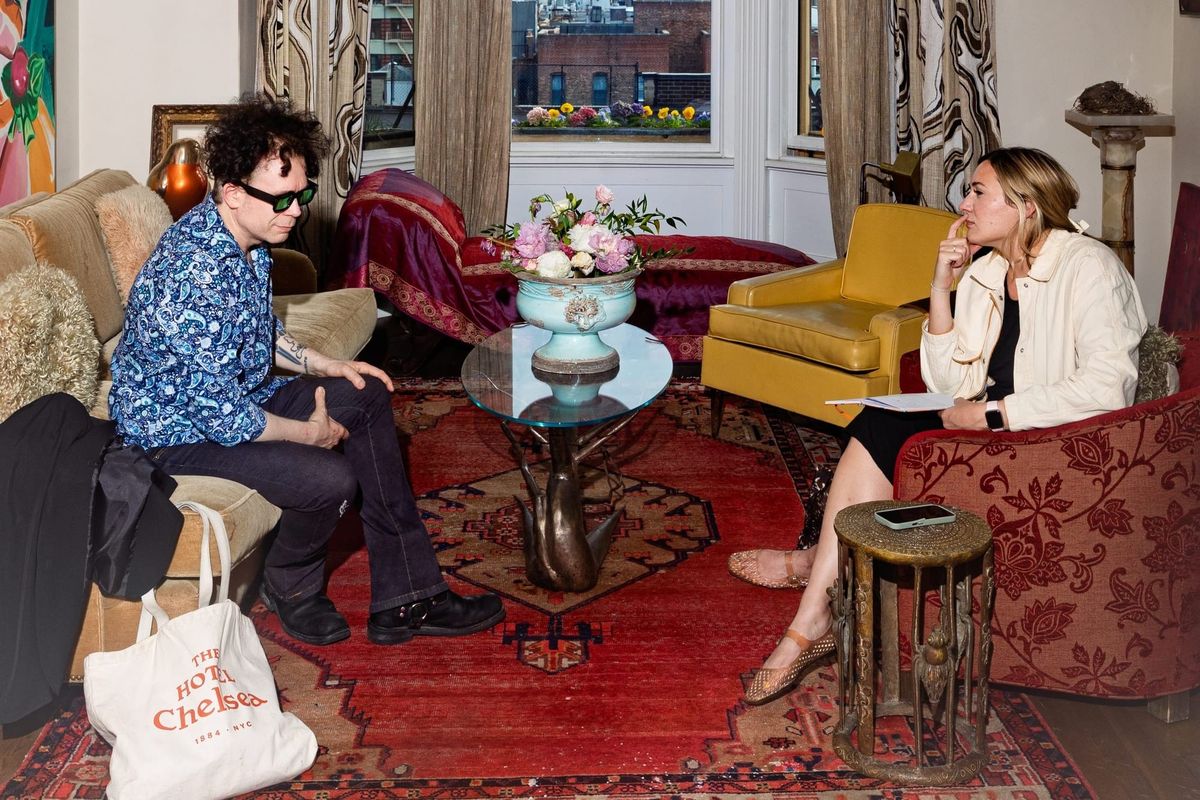
I arrive for our interview at the hotel the following week. Per Benton’s instruction, our photographer and I slip quietly past the patrons, residents and designer dogs trailing through the lobby, nod a polite hello to the desk concierges, and glide to the elevator. We’re careful to blend into the setting, like we’ve been here countless times. The truth is, I’m cos-playing belonging in a place I’ve only ever experienced in movies, books and songs, save for a couple of famously cold martinis at the Lobby Bar.
The Hotel Chelsea is iconic, but also a little untouchable; the kind of storied, glamorous place reserved for very posh, or very alternative, characters. Moving seamlessly through it now, making our way to a private residence, feels both chic and a little subversive—though I’m aware that this too, is part of my projection: that I still want it to be those things, despite what it’s become.
Today, The Chelsea is as ritzy as it once was unruly. Originally conceived as one of the city’s earliest cooperative housing experiments, the building was designed with New York’s creative class in mind. In its heyday, starving artists reportedly paid their rent with paintings, some of which are still rumored to line the hotel’s art-draped halls.
Decades ago, those halls housed an astonishing cast of characters: Bob Dylan, Dylan Thomas, Allen Ginsberg, Edie Sedgwick, Patti Smith, Leonard Cohen, Joan Baez, Andy Warhol and, most infamously, Sid Vicious and Nancy Spungen. By the late 20th century, The Chelsea’s mythology had become inseparable from the history of rock and roll, Beat poetry, punk, visual art and New York itself—understood as a place where masterpieces and tragic disasters collided on the same floors.
But time has a way of wearing down the edges of things, and even the legendary Hotel Chelsea wasn’t immune to its softening. After changing ownership, the building closed for renovations in 2011 and sat behind scaffolding for more than a decade, before reopening as a luxury hotel in 2022. Today, only a small number of its long-term artist-era residences remain. The rest of the building welcomes travelers, happy houring professionals, well-heeled socialites and music pilgrims hoping for a brush with the magic said to still linger in its hallowed halls.
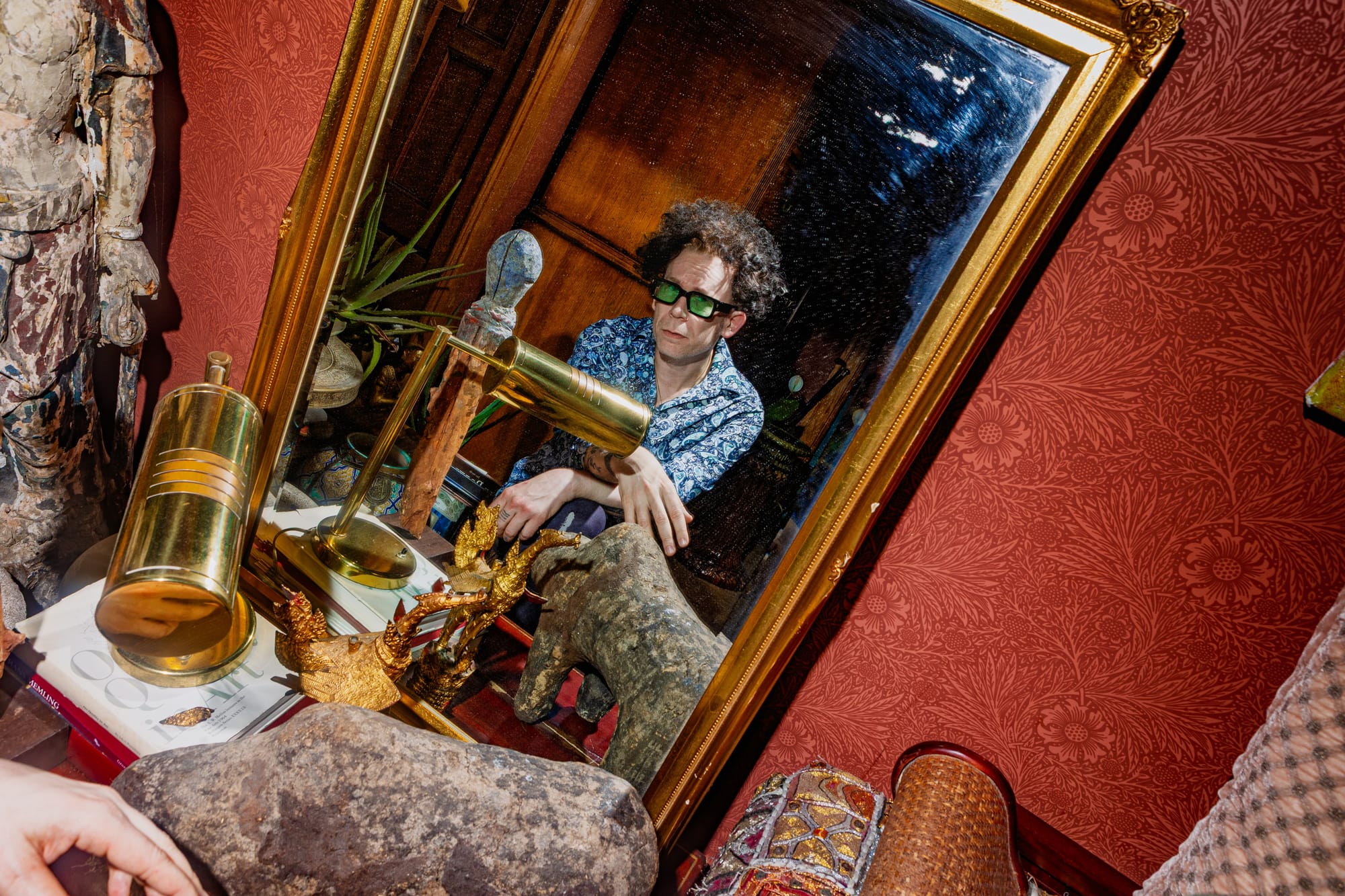
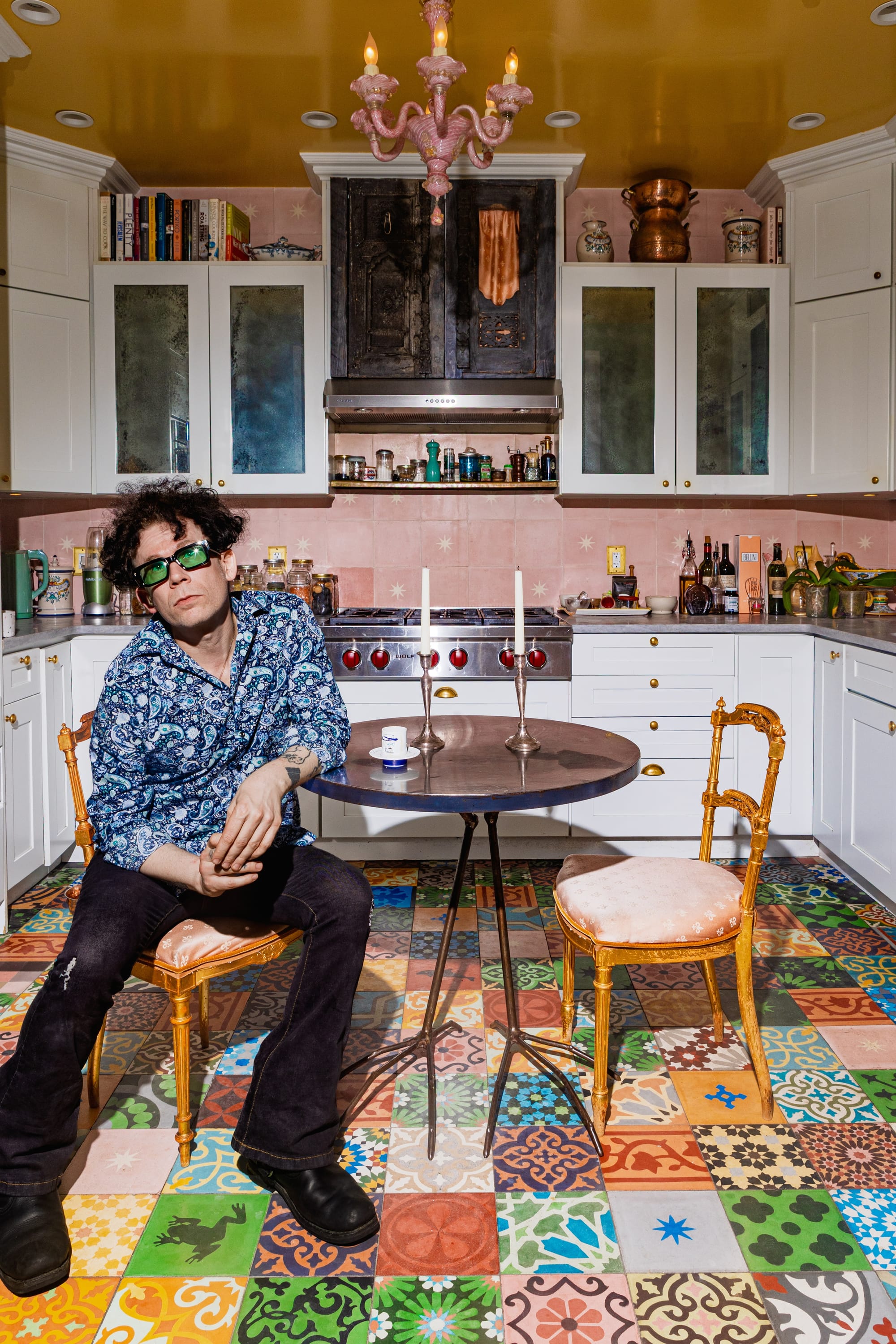
I knock on a sixth floor apartment door and am greeted by a tattooed man in chic sunglasses, with a shock of dark hair mussed out in all directions, as if lightly electrocuted. Benton has secured the apartment of Michael and Shelia Rips, an author and artist, respectively, for our interview. The apartment, objectively and subjectively gorgeous, is recently restored, drenched in golden hour sunlight, dripping with art. It’s the kind of place I want to commit to memory, and before leaving, I steal a few iPhone snaps of its odd corners and mise en scène. Being here, Benton tells me, is “a pretty rare opportunity.”
Since 2022, Benton has greeted and guided Hotel Chelsea guests and residents as they cross the threshold from 23rd Street, as its mostly official Tour Guide. After arriving to work the front desk, Benton requested to move around a bit—carry bags, deliver packages. He started to absorb the stories of The Chelsea he’d studied growing up, the same ones that would eventually elevate him to tour guide and historian.
So what exactly does playing the role of historian at a place as culturally singular and iconic as The Chelsea entail? I ask if the hotel tours he gives follow a formula, and he says definitively not.
In the elevator to the top floor, where he starts most tours, Benton uses the time to understand the guest beside him: what brought them here, what they already know. He sifts for inklings and intuits curiosities like a fortune teller or psychic medium might, weaving it together into a version of the Hotel that feels uniquely suited to them.
“I like to know why you’re here, and what brought you to the Chelsea.”
After all, everyone who makes the pilgrimage there is searching for something.
Benton himself is a bit of a troubadour. Historian by day, frontman of Cat Casual & The Final Word by night (supported on drums by Steve Shirley of Sonic Youth and Cat Power, along with Greg Eckelman on bass, and Rob Morrison on pedal steel). In the character sketch of my mind I paint him as a traveling artist, always moving from one stage to the next. Not a chameleon, but a renaissance man.
I ask if that description feels right, and he skirts the question.
“It’s a pretty good policy not to describe yourself,” he says. “That probably comes from growing up poor.”
Long before he became tour guide at the Chelsea, Benton was a kid in western Oklahoma (born in Buffalo, raised near Woodward), seduced by the far-off siren song of ’70s and ’80s punk, dreaming of getting closer to the music and art that kept him company through adolescence.
“Punk is important to me because it caused me to leave home,” he says, describing the sub-culture that first called him away to grittier pastures. After high school, he worked the oil fields until he saved up enough money—seven hundred dollars, to be exact—to leave.
“Then I was off to trouble the rest of the world in various capacities,” he recalls.
Hearing him tell his origin story, I’m struck by how a person from rural Oklahoma winds up installed as cultural keeper at one of the most iconic hotels in the world.
“It’s a strange trajectory from here to there,” he tells me.
Though he’s lightened his embargo on Oklahoma considerably in recent years—especially after the passing of his father a few years back—he has a complicated relationship with his home state.
“I feel some resentment and shame for where I came from,” he says.
“Don’t we all?” our photographer, another Okie ex-pat, interjects while snapping candids.
All three of us left Oklahoma to make something bigger of ourselves. We all admit that there’s a restlessness wrought by our home state, but also that it could be a competitive edge. There’s something in Oklahoma’s underdog spirit that fosters an outsider attitude and an innate drive to prove something that someone born and bred in a creative mecca like New York or L.A. might never understand.
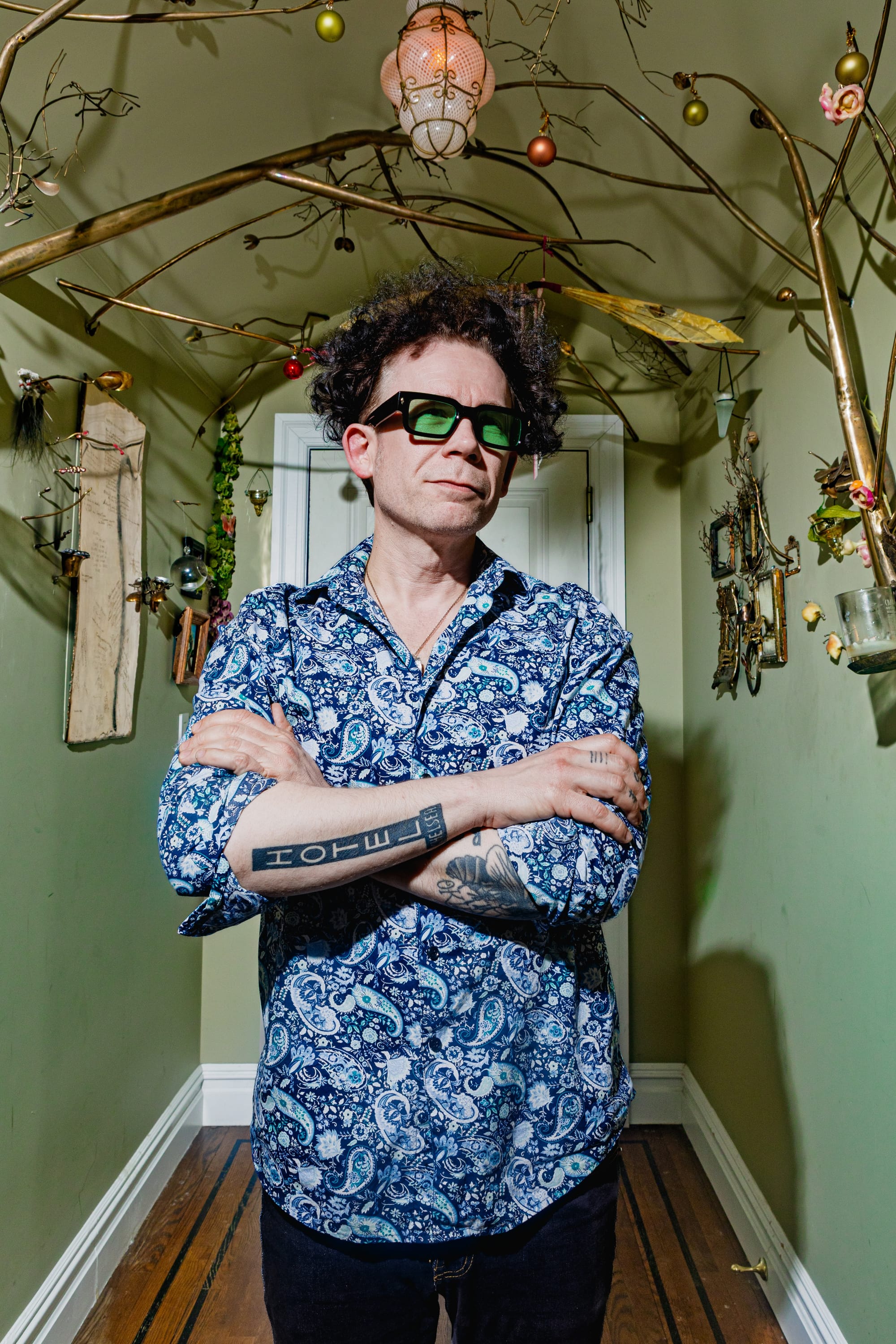
In the same breath, Benton credits his upbringing in Oklahoma (by way of his parents’ influence) with exposing him to the interests and cultural influences that brought him to where he is today: musicians like the Prince of Cool, Chet Baker; the legendary Karen Dalton, dubbed by many “the female Woody Guthrie;” Devo, whose influence was so significant on Benton that he memorialized it with a Devo tattoo; comedy greats like Kids in the Hall; and Jimmy Webb, who penned iconic hits like “Wichita Lineman,” for the likes of Glen Campbell, Frank Sinatra, The Supremes, Linda Ronstadt and others, and who as it were, attended the same Baptist church Benton’s family did in Ninnekah.
In fact, the farther he traveled from Oklahoma, the more he found himself running into it: in the musicians he admired, and even in the chance encounters with strangers turned kindred spirits who recognized something familiar in his accent.
Benton tells a story of an afternoon at Coney Island, where a boardwalk shop-worker recognized his accent as distinctly Oklahoman. She led him to the back of the shop and introduced him to a fellow Okie, who encouraged him to apply for a part-time job.
“You don’t have to be from Oklahoma to work here,” she said, “but it doesn’t hurt.”
Some people come to The Chelsea hoping to stand where Bob Dylan wrote Blonde on Blonde. Others come looking for Leonard Cohen, Patti Smith, Dylan Thomas, Warhol, Kerouac or other ghosts of a now-vanished New York. Beneath those desires is a quieter longing: evidence that their own story belongs inside a larger one. Benton came, I think, to find himself.
“Everything I know about this place is an osmosis of all my interests,” he insists, “from literature to film, music, the Beats, Warhol, punk.”
Those interests keep Benton busy. These days, he’s mixing a new Cat Casual record (which he said someone once described as “country-contaminated punk rock”), soundtracking and sitting for documentary interviews, spinning ’90s country records at his listening room residency, and of course, giving tours of the hotel (harder to come by these days, and available only to guests by appointment).
Hold it all up together, and it’s easy to understand how Benton got where he is today: He’s curious. Unassuming. A sponge for interesting information. Privately contrarian but publicly hospitable. Transient, like the original icons of the hotel, and proof that home—as it turns out—isn’t a place, but the ability to find and recognize yourself in unexpected places.
“If I could tell 17-year-old-me that I’d be doing this … I mean today, I see the sign, and try to remember what I would’ve given back then to be where I am now. Just standing at the door would’ve been blowing my mind.”
It’s a door that he never thought he’d be standing at, but proudly holds open today. Benton was an outsider in Oklahoma, and in many ways, he’s still an outsider now. Despite what many think, he doesn’t live at The Chelsea; he commutes. His domain is not the residences, but the halls themselves—hallowed, eccentric, full of stories. There’s no hotel in the world more storied or famous than The Chelsea, and no one better to represent its guiding motif—that art and wandering go hand in hand—or to acquaint a visitor with its ghosts than William Benton: doorman, tour guide, troubadour, renaissance man. •
