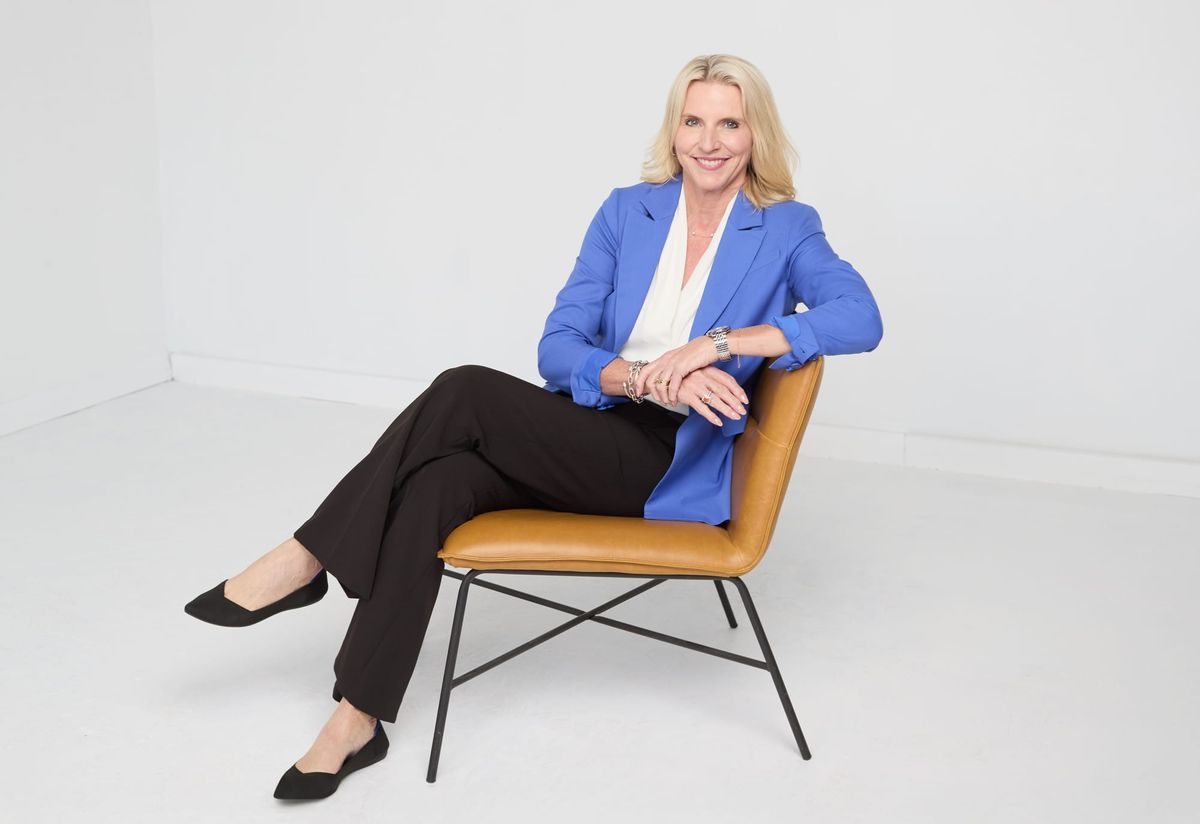
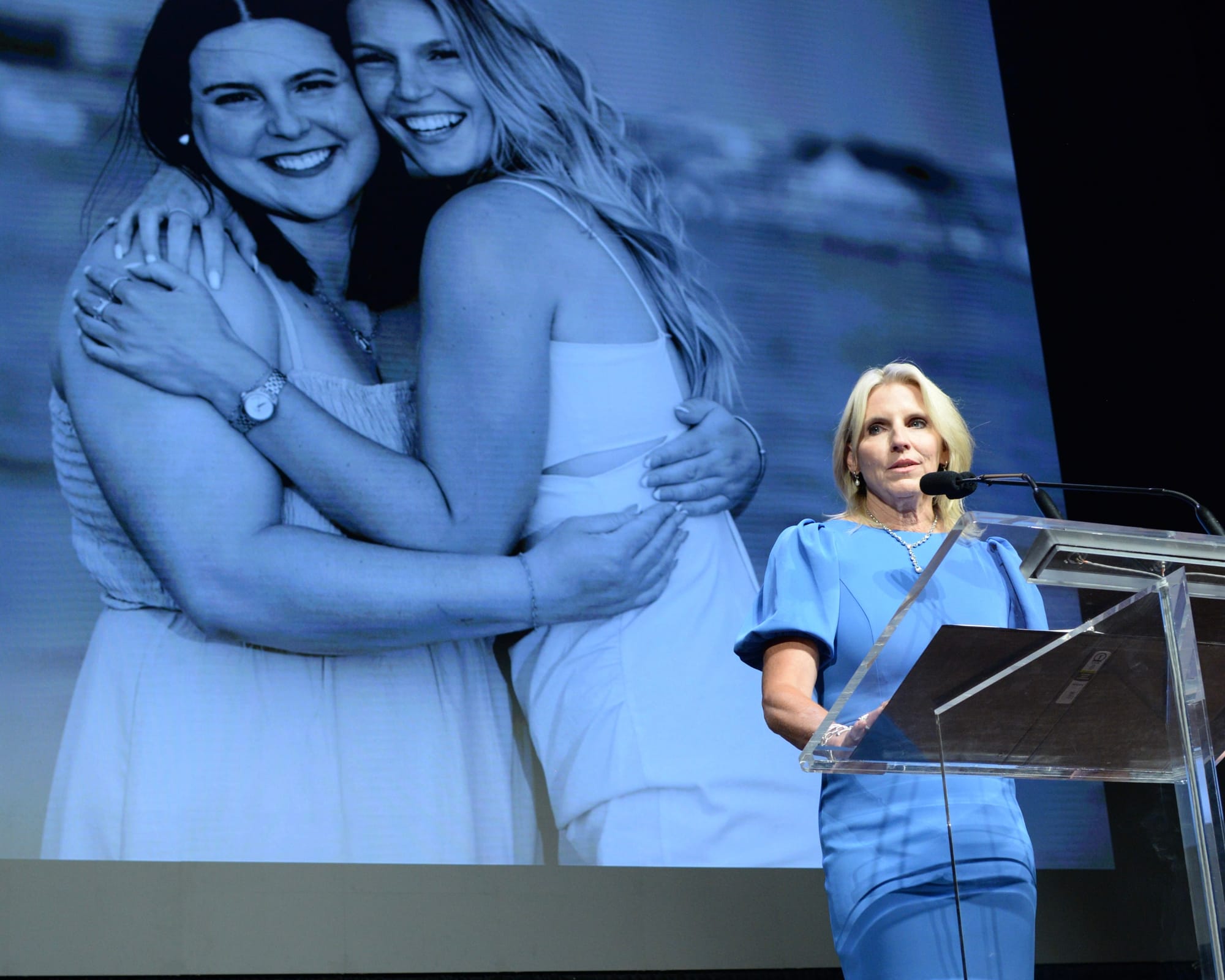
To understand AJ Griffin—Ed.D., CEO of Potts Family Foundation and former Oklahoma State Senator—there’s one thing you need to know that explains it all. Of course that’s not true, but it almost is. Griffin is a woman of many parts. She’s a powerhouse for good, a charismatic speaker, a high-caliber leader at the helm of one of the most respected charitable foundations in the state.
Like most people, though, she does have a through line: She sees the world in systems, which need the right combination of parts to function correctly. She’s been a teacher, a corporate executive, a nonprofit CEO, a state senator and (drum roll, please) a drum major for Oklahoma State University. It’s this last crucial bit that illustrates how her brain works—has always worked—and this fact informs everything she does.
“I was one of three drum majors. Our role was to be the on- and off-field leaders of the marching band. I was probably a mediocre musician but a pretty talented marcher, but they really leaned on me for some of the leadership pieces,” she says.
Of course they did. Anyone would. She’s a natural leader. “If you think about a marching band, everybody’s got to be in step, literally. If one person is out of step, it ruins the performance. And you’ve also got to have the right sections. A marching band that doesn’t have any piccolos is incomplete, but it also needs tubas and snare drums. Everybody’s role is very different, but if one of those roles is missing, then the performance isn’t complete.”
A well-functioning system keeps a marching band humming, she said. The same is true for societal support structures. “I like to work in systems,” she says. “I’ve been drawn to looking at big problems that have lots of moving parts, and how to get those parts to work together, and there’s probably nothing that symbolizes how systems work better than a marching band performance.”
Another concept that informs Griffin’s personal and professional ethos is hospitality, which shows up in the way she approaches the Potts Family Foundation board and partners, her colleagues, grantees, her staff, her kids … everyone. “Hospitality is more powerful than charity,” she says.
It makes sense that her undergraduate degree is in hotel and restaurant administration. At 21, she was managing a 75-employee restaurant, working about 60 hours a week. Not sustainable, even for someone with Griffin’s boundless energy. “If you know the restaurant industry, you know it will wear you out pretty quickly, so I transitioned from that into education, teaching hospitality and food service production in a career technology center,” she says. After the career tech, Griffin taught junior high family and consumer science in Guthrie Public Schools, her favorite job ever.
Another pivot landed her in the nonprofit world, as one of the first state coordinators for Smart Start Oklahoma (now the Oklahoma Partnership for School Readiness), an early-childhood initiative designed to ensure children are safe, healthy and ready to succeed by the time they enter school. “Smart Start was adopted, ironically, through a lot of hard work by Pat Potts. She encouraged Oklahomans to focus on early childhood, and so Smart Start became a statewide initiative focused on fostering healthy early childhood by working at the local level.” Later, when another nonprofit in Logan County needed an executive director, Griffin took the position.
Griffin served two terms in the Oklahoma State Senate, where she authored and passed landmark legislation to enhance the lives of children and families. These legislative efforts included autism treatment insurance coverage; foster care and juvenile justice system transformations; criminal justice reform; and expanded healthcare access. Her legislative work earned her numerous accolades, including the Kate Barnard Child Advocate of the Year award.
In the legislature, she quickly understood that it’s all one big system, and every lever that gets pulled affects the whole thing either positively or negatively. “Every tax change, every piece of legislation impacts the whole system, up and down, all levels of government. You can’t make a single change and not think it’s going to impact families,” she says.
After leaving the senate, Griffin entered the corporate world, serving as the director of government and community affairs for Paycom.
Each piece of Griffin’s career path has built neatly on the one that came before, and each has been focused on improving the lives of Oklahomans, albeit from different angles. Talk to her for more than a few minutes and you’ll hear her say that she works on behalf of the most important people in the world: babies. And if you want to support babies, you’ve got to support families.
What’s missing for Oklahoma families now, Griffin said, is access to basic economic support structures: family-sustaining jobs, affordable health and access to health care, housing and good community schools. “These are basic things, but if you’ve got a neighborhood or a town where there’s one piece of it missing, that family living in that town isn’t able to function properly; it’s going to be off-kilter. If you don’t have access to health care in your proximity, then accessing healthcare becomes a significant burden. You’re taking days off of work to go see doctors, and it makes life significantly harder, and for many communities in Oklahoma, that is the reality.”
Griffin believes that with the right support framework and systems functioning properly, our communities, and therefore our families, can become whole once again. “I believe there is a misperception about families—that individuals and families are completely responsible for themselves,” she says. “And that’s true to a point. It’s not the responsibility of any leader to fix someone else’s problems. However, it is the responsibility of leaders in communities, and states, and countries to ensure that the tools and resources necessary for success are available.”
Back to her apt marching band analogy, “In large systems, even if we have one piece that’s performing really well, if it’s not surrounded by other all the other necessary components, it doesn’t matter—we just don’t get the result that we want.”
The goal at Potts is to work with families, social services, education and business, endeavoring to break down the longstanding siloes that can inhibit healthy cross-pollination between them. “Families are systems as well,” she says. “Everybody in a family plays a different role, but if one person in the family is unhealthy, it can’t function effectively.”
Whether it’s a health problem or another issue, if families are clipping along and there’s a sudden serious challenge, the family can’t work as well as it should. “Right now, we’re in an era when we’re providing communities with broken equipment or no equipment at all and expecting them to perform. We’re expecting families to thrive in those conditions, and it’s an impossible expectation,” she says. “We’ve got to start treating families as the systems that they are, and the communities that surround them need to be complete. That’s how to create an environment where families can thrive.” •
The Luxiere List: About Potts Family Foundation
Potts Family Foundation (PFF) is an operating foundation focusing on providing support for sustainable early childhood initiatives with an emphasis on root causes, leveraging resources for the greatest impact through collaborative partnerships and securing sustainability and the potential replication of evidence-based programs and services that lead to building resilient children, families and communities.
The link has been copied!
Your link has expired. Please request a new one.
Your link has expired. Please request a new one.
Your link has expired. Please request a new one.
Great! You've successfully signed up.
Great! You've successfully signed up.
Welcome back! You've successfully signed in.
Success! You now have access to additional content.