
Connecting With The Soul of Dining
How Living Kitchen’s creators are helping shape Tulsa as a food city

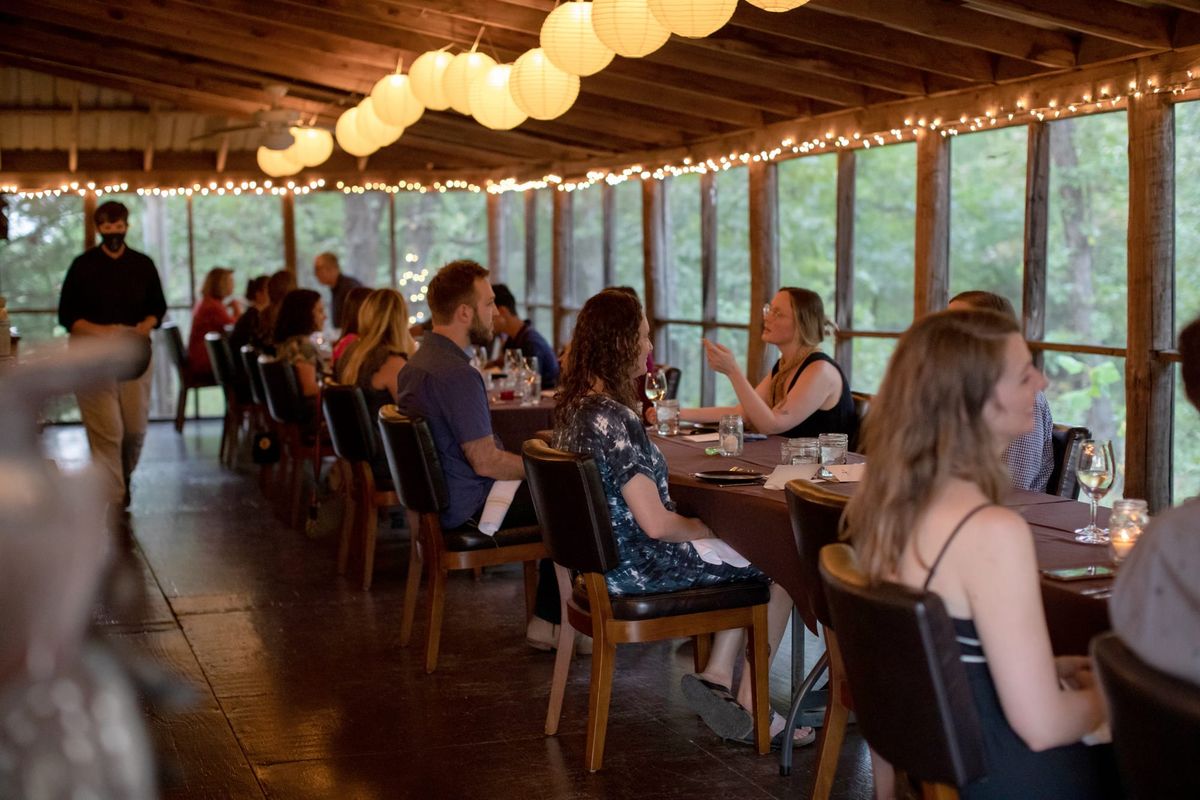
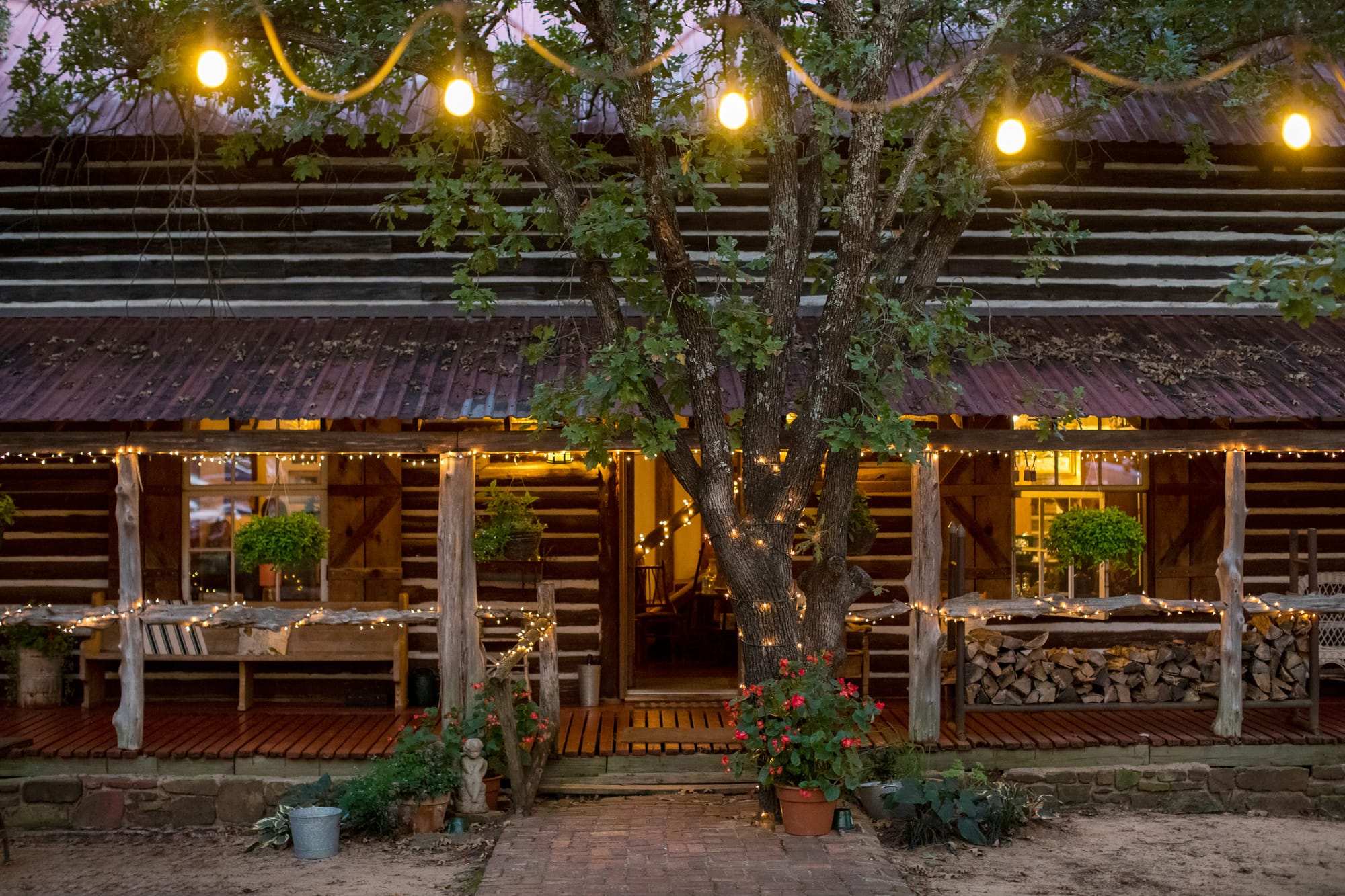
Halfway between Tulsa and Oklahoma City, at the end of a gravel road flanked by post oak, blackjack and pecan trees, there’s a portal disguised as a house. To the naked eye, it’s a log cabin: humble, rugged, hugged on all sides by a wrap-around porch. But for thousands of people—those who have come to dinner on its back porch; tasted the sweetness of its heirloom vegetables as cicadas sing out from the trees—it is a world unto itself. Not a restaurant, but a living, breathing kitchen.
Chalk it up to the menus, the romance of the setting or the conversations that unfold between courses. We have the land to thank for the first two, but the last one requires a human touch.
“We do a little bit of research on who’s coming to dinner,” admits Linda Ford, co-owner of Living Kitchen Farm & Dairy. “But mostly just enough to get a sense of who people are.”
The people who come to Living Kitchen, it would seem, are the kind who crave connection, and who appreciate the work that goes into creating it. I’ve been fortunate enough to dine at Living Kitchen many times over the past decade with friends, family and lovers. No matter the company, the evening always ends in sharing stories, wine and phone numbers with the strangers around the table. That’s the magic of the place: It makes you want to lean in, linger a little longer and commune.
After my father died, still shell-shocked by the loss and wary of being ambushed by grief anywhere too public, I wasn’t ready for crowded rooms. With a loft upstairs and a forest a thousand trees deep to disappear into should a grief wave strike, an intimate dinner on the Living Kitchen porch felt like a safe place to re-enter the world.
I found myself making conversation in between courses with the man across from me—a self-proclaimed “Disney Adult,” with whom I seemed to have very little in common at first blush. Remarkably, somewhere around the third course, it became clear that what this man really needed to discuss was the grief he’d been carrying from losing his own father a few years earlier. He’d booked a seat at the dinner looking for a bit of levity; something new to lift the blues. When I told him I knew the feeling, and that I’d lost my own dad just the week before, a door opened between us. Was it kismet, or the unseen work of some other steward?
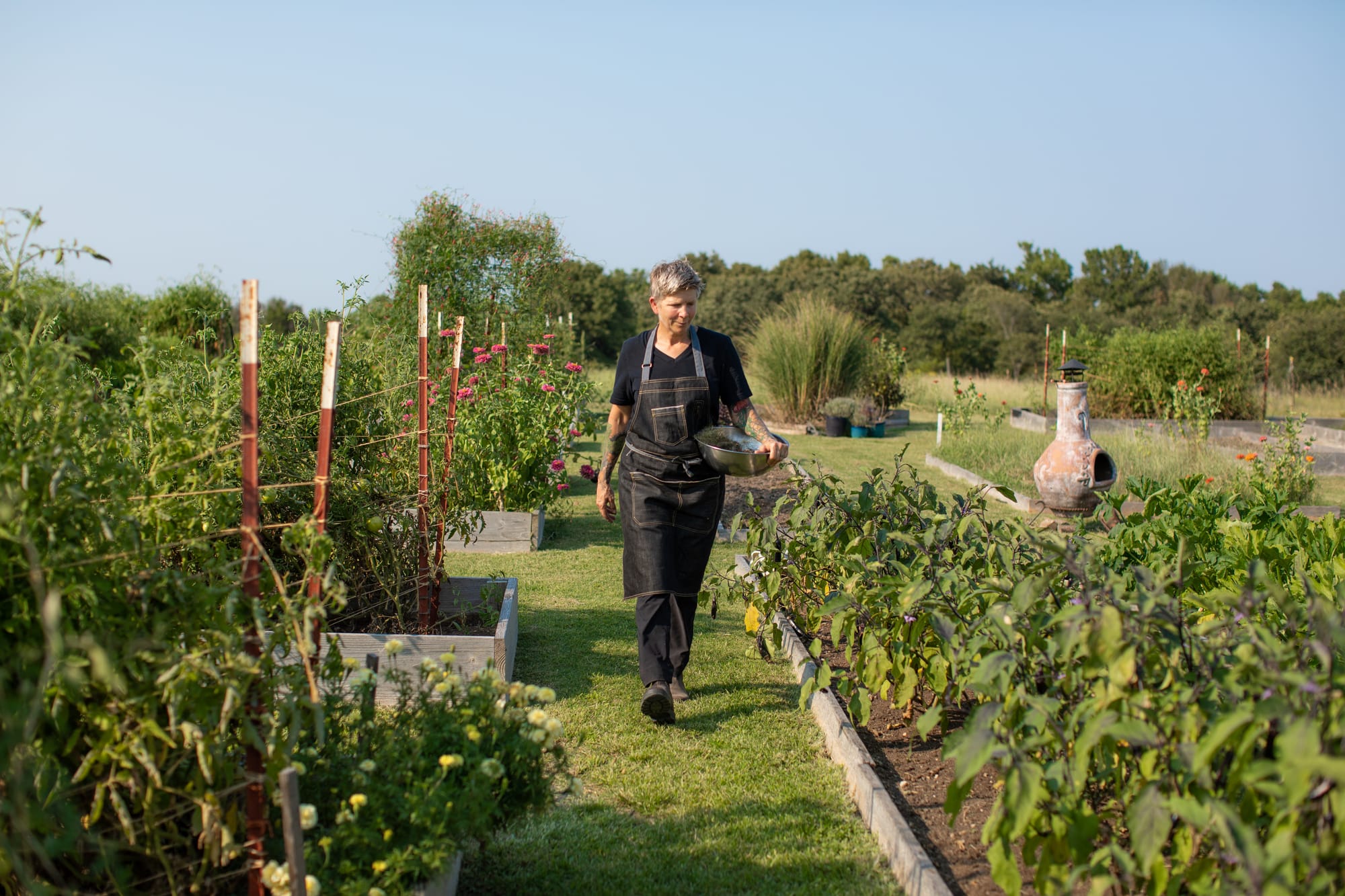
“It’s less about making connections,” Ford insists of her research on guests, “as much as it’s about removing the barriers that might keep us from connecting.
“We trust our guests will find their way to the things they have in common.”
All of Living Kitchen’s dinners are prepared with locally grown bounty, and unfold around a bespoke theme: smoked and wood-fired meats one night, a 10-course ode to Oklahoma-grown tomatoes or strawberries another. Some dinners take the theme a step further with poems or art, chosen to create a true “feast for the senses.” Intimate, thought-provoking and carefully assembled, each dinner reads like a love letter to the land, and to those of us lucky enough to be on it.
Despite its roots in church potlucks and backyard barbecues, communal dining still feels novel in parts of Oklahoma. It’s this that makes Living Kitchen so singular, even counter-cultural. In an era marked by automation, instant everything and hyper-individualism, Living Kitchen offers a welcome reprieve: Slow down, appreciate the harvest, break bread, talk to someone you do not understand until you begin to, take care of each other. These things aren’t just dinner theatre, but the norms that give the experience its soul.
When I asked chef and co-owner Lisa Becklund about the ethos of the farm—what animates her concepts, and what inspires her team to keep pouring into these dinners season after season, she hesitated to answer.
“God, I don’t know—that’s a loaded question,” she says.
“I think the ethos is love, care, and respect for our craft and for our guests. We go into each dinner with those intentions, and the guests bring the magic. Linda does such a wonderful job putting the right people next to the right people. There’s such a sense of community.”
The Living Kitchen operation has come a long way since starting two decades ago. What began as dinners in Becklund’s home quickly grew and moved to the farm in 2009, where her bespoke dinners developed an unusually devoted following; each season, seats regularly sell out within minutes of going on sale.
With the farm bound by realities of space, time and weather, the demand posed a new question: How might we translate the spirit of Living Kitchen into something people can experience year-round?
In August 2020, fresh off the restaurant industry’s COVID-era upheaval, Lisa and Linda opened FarmBar, an intimate tasting-menu restaurant tucked away in Tulsa’s South Boston neighborhood, and seemingly their first attempt at answering that question. FarmBar trades the cabin’s wraparound porch for an open concept dining room, but not its core philosophy: The harvest is the show, with seasonal menus built around locally sourced ingredients grown exclusively in the region.
Oklahoma’s changing harvest also drives the menu at Il Seme—the Italian restaurant Ford and Becklund opened in 2022—but the restaurant feels more bohemian cousin than little sister to Living Kitchen and FarmBar. Known for its housemade pastas, locals love Il Seme’s “Spaghetti Western” special, when a plate of red-sauce spaghetti and meatballs with a salad is just $18 on Wednesday nights.
In 2025, Ford and Becklund dug deeper into their farm roots and opened Cow & Cabbage, a specialty market in Tulsa’s former Grassroots Larder space. The market sold hyper-local meats, dairy and produce, artisan goods and grab-and-go items, with a small menu of elevated blue-plate specials, like a griddle-fried catfish and braised short rib.
Cow & Cabbage seemed like it should’ve been a hit on bustling Cherry Street, where a half-mile row of retail businesses, restaurants and bars yields a steady stream of foot traffic, but the concept struggled to take root. Social media appeals to FarmBar and Il Seme fans did little to turn the tide, except perhaps siphon off business from the group’s other concepts. Guests complained on Reddit threads about its premium prices, and Cow & Cabbage ultimately closed this May after just one year of operation.
“It was a combination of not having enough traffic, but that was mainly brought on by paying substantial rent because of the space,” Ford reasons. “It just didn’t happen.”
“We learned a lot and will cherish that educational experience,” Becklund says. “We gave 100,000% and just couldn’t make it happen.”
Tulsa is undeniably becoming a more ambitious food city, earning growing attention from institutions like The New York Times and the James Beard Awards. In 2025, Cat Cox—owner of Country Bird Bakery and the former guiding hand of Living Kitchen’s bread program—won the James Beard Award for Outstanding Pastry Chef, one of the restaurant industry’s highest honors, while operating a tiny Tulsa bakery open just two days a week.
Cow & Cabbage’s arrival was part of a wave of ambitious restaurant openings signaling a new chapter for Tulsa’s dining scene. Its closure comes at a moment when chefs, restaurateurs and even philanthropists are investing heavily in the city’s culinary future—and is a stark reminder that opening a charming restaurant and sustaining it are two very different beasts. The latter requires consistent execution, constant refinement, financial discipline, exceptional hospitality, strong management ... and most importantly, a flow of diners willing to return after the novelty wears off.
Both Living Kitchen and Cow & Cabbage ask something of their customers beyond money. At Living Kitchen, the ask is to slow down, eat with a stranger and linger. Cow & Cabbage asked shoppers to pay more for things grown locally, change their habits and support producers who couldn’t otherwise survive without it. They ask for our attention, and our participation.
Tulsa wants to be the kind of city where restaurants like Cow & Cabbage exist. But wanting those restaurants and supporting them consistently are two different things. Its closure raises an uncomfortable question about the city’s culinary ambitions: Can Tulsa sustain concepts that ask this much of us? Can super-niche, hyper-local restaurants commonly found in larger food capitals thrive in places like Tulsa? Or is rarity—much like Living Kitchen’s sold-out appeal—part of what makes them special?
“Tulsa is a cute, beautiful city. OKC is really interesting, too. But we don’t have the population density of a place like Seattle,” Becklund reasons. “The advantage is that the rent should be a little cheaper here than in those other cities. You just have to know the numbers.”
“I do think there’s a need to educate and engage people around new concepts,” Ford adds. “But if you can take the ambition and innovation of a concept and marry it to a deep, abiding respect for the people here and what they appreciate, and find ways to help them get on board with it ... there’s plenty of room.”
Come September, when Oklahoma’s oppressive heat finally starts to taper off, Living Kitchen returns with its most anticipated dinners of the year: the eponymous Fall Harvest dinner, celebrating the season’s bounty; Cascadia, a new menu inspired by Lisa’s two homes in the Pacific Northwest and Oklahoma; and the return of the fan-favorite Dinner for Poets, where guests feast on plates and poems throughout the evening.
The dinners continue through the fall, culminating in Feast Day celebrations in November and Home for the Holidays dinners in December. It’s a big undertaking, and requires the kind of stewardship that doesn’t leave room for much else.
“Personally, I’m not opening up another business,” Becklund insists. “I want to throw everything we have into our three restaurants. I want to rest and be healthy, and show up for myself and the people I get to work with. There’s no room for more.”
“At this point in our lives,” Ford adds, “we’ve become a lot more invested in pouring energy into our staff and getting them ready for current and future successes. Ultimately, how we define legacy is folks who move on from our place and start their own with the values they learned here.”
Maybe that’s the growth Lisa and Linda are tending now: not more restaurants, but better ones—and more people prepared to build thoughtful tables and connections of their own. And if we’re all lucky, more people gathered around the table, sustaining it for years to come.
“We want to be good ancestors,” Becklund says. “I kind of need to feel like that’s enough.” •
