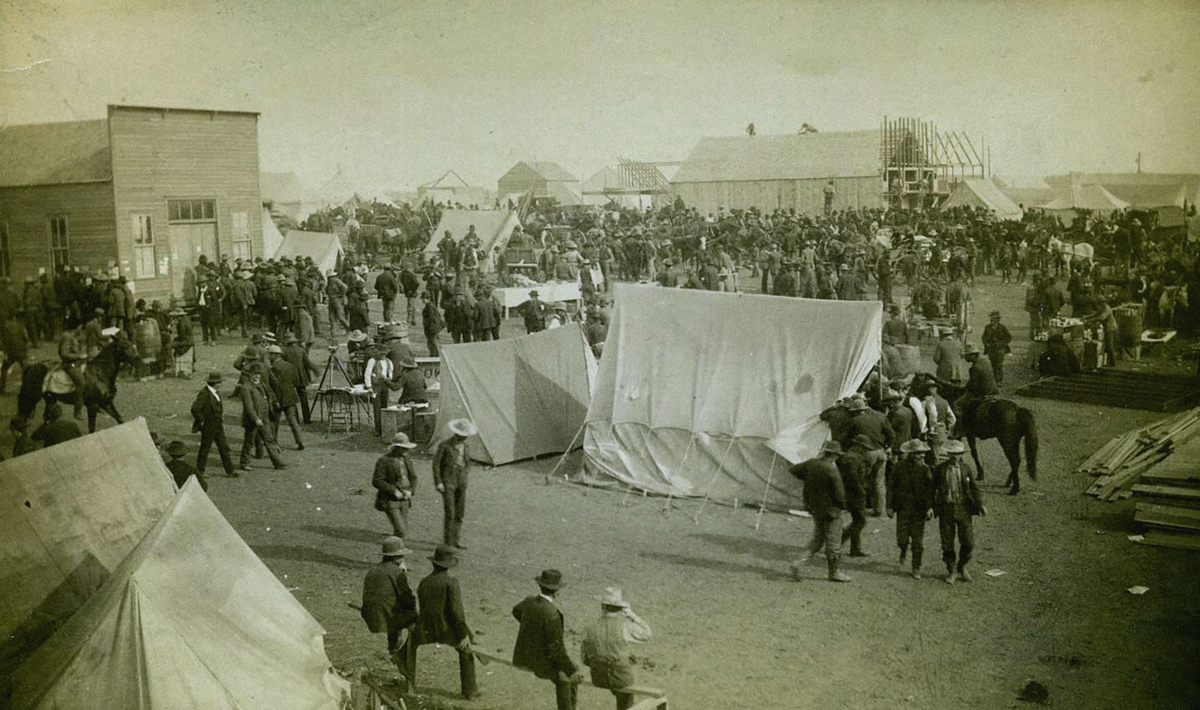
Guthrie, Oklahoma, at 10 days old during the Land Run of 1889, photograph courtesy of Oklahoma Historical Society
Have you ever found yourself wondering about the state of Oklahoma’s banking industry? Curious about its history, interested in what comes next and hoping to make cents of it all? (See what we did there?) Puns aside, we were too. In an effort to offer a comprehensive snapshot, Luxiere recently spoke with three men—Mel Martin, President & CEO of First National Bank of Oklahoma (FNB); Kyle Powell, CEO of Kirkpatrick Bank; and David Harlow, CEO of BancFirst Corporation—about the current and future fiduciary forecast for the banking industry in Oklahoma. Spoiler alert: It’s sunny!
Before we talk about the here and now, let’s take a brisk walk down memory lane, to ask, as David Byrne might put it, “Well, how did we get here?”
Before statehood, in the late 1800s, banking functions were largely undertaken in an ad hoc, fully unregulated manner by Indian Territory mercantile owners like James A. Patterson in Muskogee, or within the Choctaw Nation by the Doak and Times Mercantile Company, which served as general store and bank, as did its prime competitor, Berthelet, Heald and Company.
In 1907, after the Land Runs in central and western Oklahoma, some 883 banks sprouted up from the prairie like wild indigo after a spring rain. Within days of April 22, 1889, at least nine banks opened for business, albeit in tents or shacks. Back then, anyone who could get folks to make deposits could open a bank. Early regulations like the National Banking Act (1863) and the Organic Act (1890) only applied to national banks—most of Oklahoma’s were private. Modern, regulated banking began in Indian Territory in 1897, when a regulatory code was passed requiring all banks to be incorporated and to operate under the supervision of a bank commissioner.
FNB was founded in 1917 as the First National Bank of Tonkawa. Oklahoma was less than 10 years old, and both the state and the Kay County region were enjoying an era of economic optimism. The great oil boom in Kay County had started in 1911. With its initial charter, the bank aimed to provide reliable financial services to the burgeoning population and businesses of Oklahoma, encompassing both oil and gas-related businesses and the region’s agricultural base.
“The current ownership group acquired control in 2001,” Martin says. “At the time we acquired the bank, it had about $50 million in assets and two locations in Kay County: the towns of Tonkawa and Ponca City. Under our ownership group, we branched back into Oklahoma City. We opened here in 2004, we opened a Tulsa office in 2018. Today, the bank has assets of about $975 million.”
Kirkpatrick Bank can trace its banking lineage to the late 1800s and Samuel Diggs Blake, a man eager to start his own businesses on the Texas frontier after the Civil War. In 1888, after ventures in wholesale clothing and groceries, he led the family’s foray into banking. He was followed by his son Mack Blake, who helped found Liberty National Bank in Oklahoma City, famously keeping it afloat during the Great Depression by mortgaging his home and leveraging other personal assets. That commitment to forging deep community partnerships remains central to the bank today.
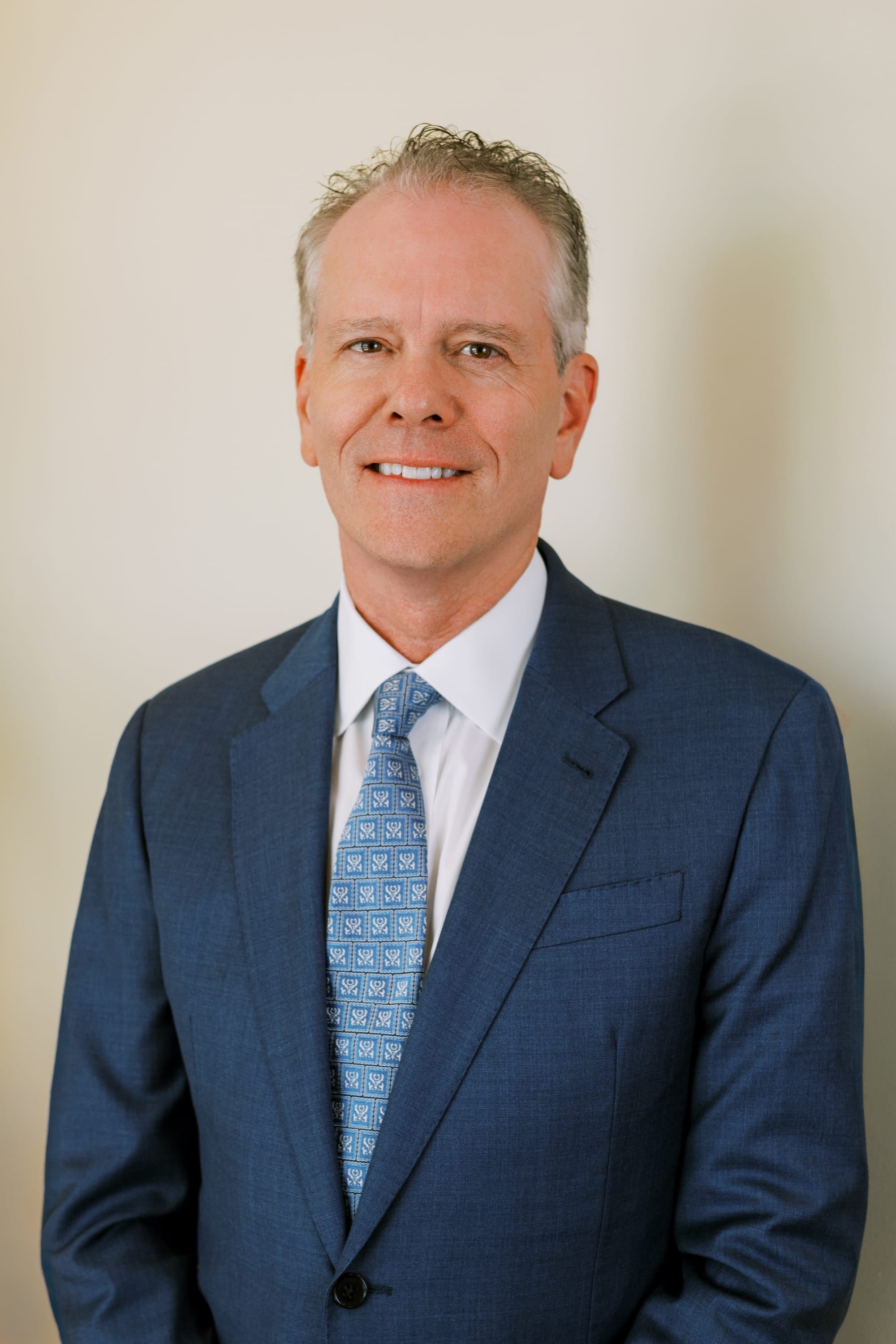
LEFT: Mel Martin, President and CEO of First National Bank of Oklahoma. MIDDLE: David Harlow, CEO of BancFirst. RIGHT: Kyle Powell, CEO of Kirkpatrick Bank
“Kirkpatrick Bank has always been very relationship-driven,” Powell says. “I often talk with my younger lenders and employees about the importance of that. The most satisfying part of this job is that human component: You take a company that’s an acorn and you plant it, and over time you get to watch it grow into a strong oak.”
BancFirst’s origin story began in 1962, when lead investor and Chairman H.E. “Gene” Rainbolt acquired the First American Bank in Purcell, followed by Federal National Bank in Shawnee a few years later. In 1967 he and a group of investors began buying more banks in Oklahoma, and initially called the result United Community Corporation, the state’s first multi-bank holding company. Over the years, BancFirst has grown exponentially while staying true to its hyper-local customer service.
“We’re in 114 locations in 63 communities in Oklahoma, and we’re publicly traded,” says Harlow. “We’re headquartered here in Oklahoma City, but we are really a statewide organization. Normally banks our size are very centralized, but we are unique. We have 37 bank presidents across the state, and we push decision-making out to the field. We set up their lending authorities and their authority to deal with probably 90% to 95% of what happens in their market, because how you are successful in Marlow is very different than how you’re successful in Tulsa. We hire local bank presidents and give them the autonomy they need to serve their communities best.”
It would be easy to yield to the siren song of technology. There’s a new app released every 45 seconds or so, and AI-driven everything seems as ubiquitous as Cosmopolitans at a 1990s happy hour. For these men, though, there’s every reason not to hop on every bandwagon that whistles by.
Martin recently met with a shareholder and the conversation turned to AI: “We were talking about it a little bit, and he said, ‘You know, Mel, in technology, there’s always something that’s being rolled out. You’ve got to have this. You’ve got to do that.’ And he said, ‘You just have to sift through all of that’ … A lot of the banks that are chasing AI, in my opinion, are likely less efficient than we are, and they need to find some efficiencies. Well, we’re already hyper efficient, so we don’t feel that same pressure.”
BancFirst, the largest in the group, takes yet another nuanced approach. “We’re not big enough that we’re developing our own software, but we’re big enough from a size perspective that we’re able to purchase,” Harlow says. “We let technology prove up, and then we can go buy it off the shelf and plug it in.”
Powell sees it this way: “You know, at the end of the day, we’re never going to be a leader in technology, we don’t have resources to do that. Large, institutional banks are going to throw everything they can against the wall to see what sticks, and they have that as part of their strategy. For us, we watch, read the tea leaves—and when the adoption rate is there, we invest in the service.” He remembers when the industry shifted from phone banking to internet banking to mobile app banking. “Nobody knew how widely they were going to be adopted, but when it was clear that customers preferred them, you quickly go into development and get that rolled out.”
While each bank’s vibe is distinct, they align in important ways. None believes they need to be on the bleeding edge of technology simply for technology’s sake. All began as Oklahoma start-up businesses. Each offers white-glove service to high net-worth clients. All take customer service—at every level—extremely seriously. And they’re all affable and people-oriented, willing to explain financial concepts to the less-savvy (such as this reporter), while making it crystal clear that they view helping clients manage their assets as an almost sacred duty. •
The link has been copied!
Your link has expired. Please request a new one.
Your link has expired. Please request a new one.
Your link has expired. Please request a new one.
Great! You've successfully signed up.
Great! You've successfully signed up.
Welcome back! You've successfully signed in.
Success! You now have access to additional content.