Musician, business leader and community activist Jabee Williams
Jabee Williams loves to tour. Standing on different stages every night, with a microphone in hand as he looks out upon sold-out crowds who are rapping his lyrics along with him—that’s what he had dreamed about since he composed his first song. It’s the type of life most musicians dream of in the beginning.
However, it didn’t take Williams long to realize he wanted more than that. As much as making music was his passion, he wanted his life to amount to more than dropping hits and entertaining crowds.
It wasn’t until Williams took on the roles of community activist and business leader that he saw himself really making a difference for the city he grew up in. The 43-year-old has evolved into a three-time Emmy Award-winning musician, educator, proprietor, mentor and community activist.
Despite all his success, Williams knows he still has a long way to go.
“I still run into kids that I worked with 10 years ago, 15 years ago, that are doing great and really appreciate the time that we spend together, thanking me and all that,” says Williams. “But I also had kids that I worked with that were killed.”
Williams could be called the unofficial mayor of Oklahoma City. Since releasing the album Black Future in 2016, his name has been attached to many of the big events surrounding Black culture in Oklahoma City. You are just as likely to find him touring a Goodwill site as you are to see him courtside at an Oklahoma City Thunder game.
This is not the life Williams envisioned for himself growing up. Until he discovered he could make money with his music, the Northwest Classen alum considered being a teacher or even a policeman.
“I was at a mentoring program that I do with Live Free Oklahoma, and part of my introduction is, I kind of walk them through my life to show them I was just like you,” Williams describes. “And I start off by asking, ‘What do you want to be when you grow up? If you don’t know, that’s okay, because I didn’t know when I was young. I had no idea what I wanted to be.’”
Origin Story
Leading up to this point in his life, Williams endured his share of tragedies and hardships. That includes losing his 16-year-old brother to gun violence when Williams was 18 years old and watching his mother, Monya Caraway, raise a family by herself.
“We made something out of nothing. For the most part, my mom was a single parent, and we struggled a lot,” says Williams. “But my mom did a good job of making sure we had everything we needed. Even though we lacked so much, she went out of her way to make sure, especially when we started to get older, that we had the things so we could keep up, and not look like we had nothing.”
Williams said his mother was working two or three jobs and at times had to pawn her jewelry to make sure the lights stayed on. But even during the times when they were homeless, Caraway kept the family together.
“She was an amazing, strong person, and still is,” Williams says. “I talk a lot in music about coming up poor, and not having anything, but I feel like those things, that struggle, helped make me who I am. I don’t like to say I had a hard childhood … it was probably harder on my mom than it was on us.”
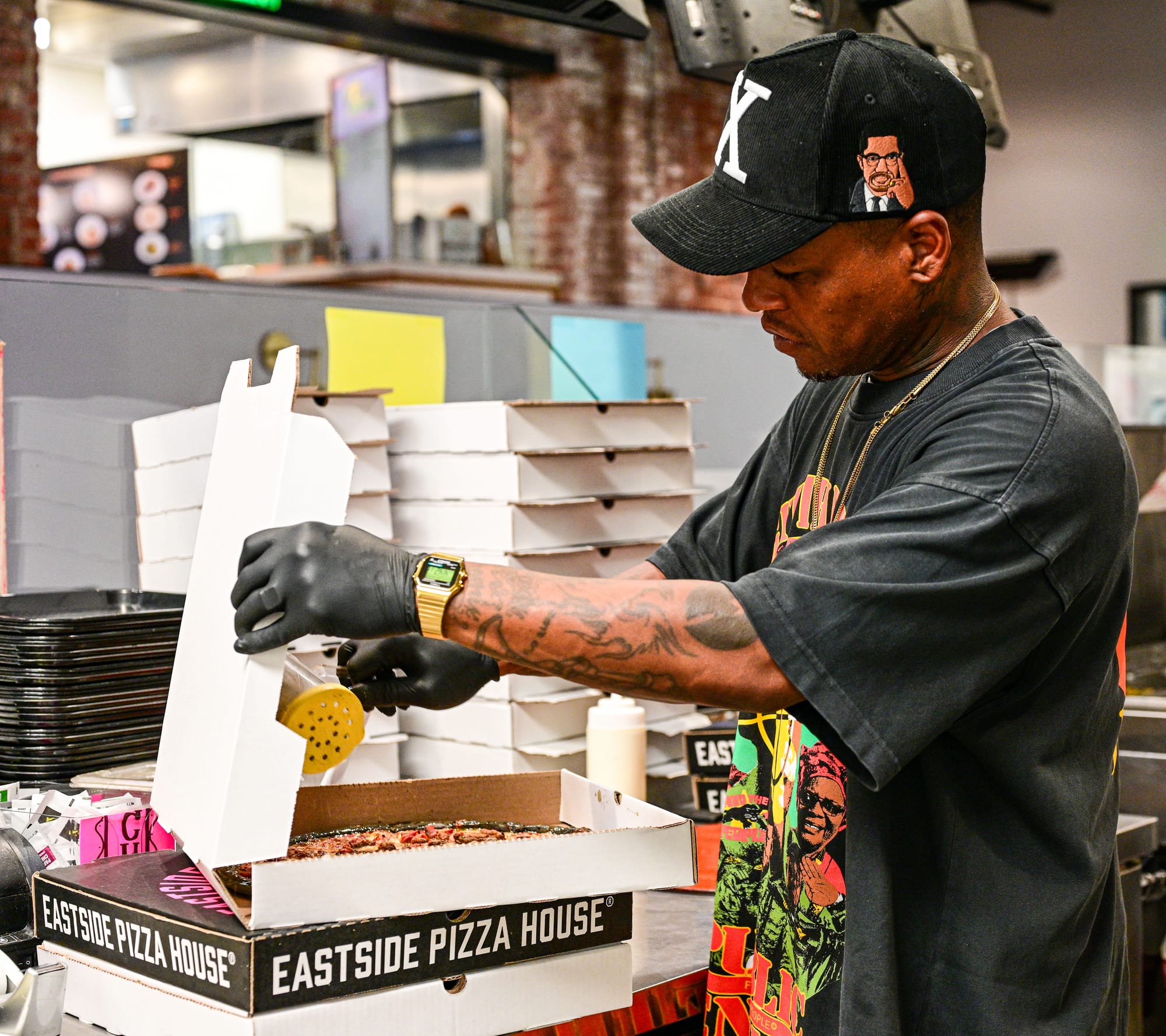
Willams seasons a pie before sending it out at OKC’s Eastside Pizza House, photograph by Michael Kinney
Consider the Community
Seeing the struggles his mother and those around him had to endure and not wanting others to have to go through losing a loved one to gun violence not only shaped Williams’ music, but it cultivated the community activist in him.
“At an early age, I had a burden for the community and a burden for my generation and the generation behind me,” he says. “I think that it’s important that whatever we do, we consider the community first.”
Even before Williams began growing in popularity for his music, he was finding ways to lift up the east side of Oklahoma City. But it was in 2023 when he launched Live Free Oklahoma that he really began to see his influence grow.
In May, after a spate of gun violence broke out at Arcadia Lake, Williams was one of the city leaders calling for Oklahoma to invest in community violence intervention.
“Live Free Oklahoma is on the frontlines of building safer, healthier communities—free from gun violence, mass incarceration and systemic injustice,” says Williams.
He also created With Love OKC, which began as an arts initiative to address a critical need for artistic and educational infrastructure in Northeast Oklahoma City. Originally called With Love Project Foundation, the collective has hosted numerous art shows and events that focus on local and often underserved communities. Recent events include the Women of Color Art Show, Juneteenth on the East and Fear of the Black Art Show.
“If I’m being real, I would love to see the city embrace Black culture in a better way,” Williams said. “We only think about Black culture and Black people in February and on Juneteenth. I would love to get to a point where we were a part of the conversation all the time.”
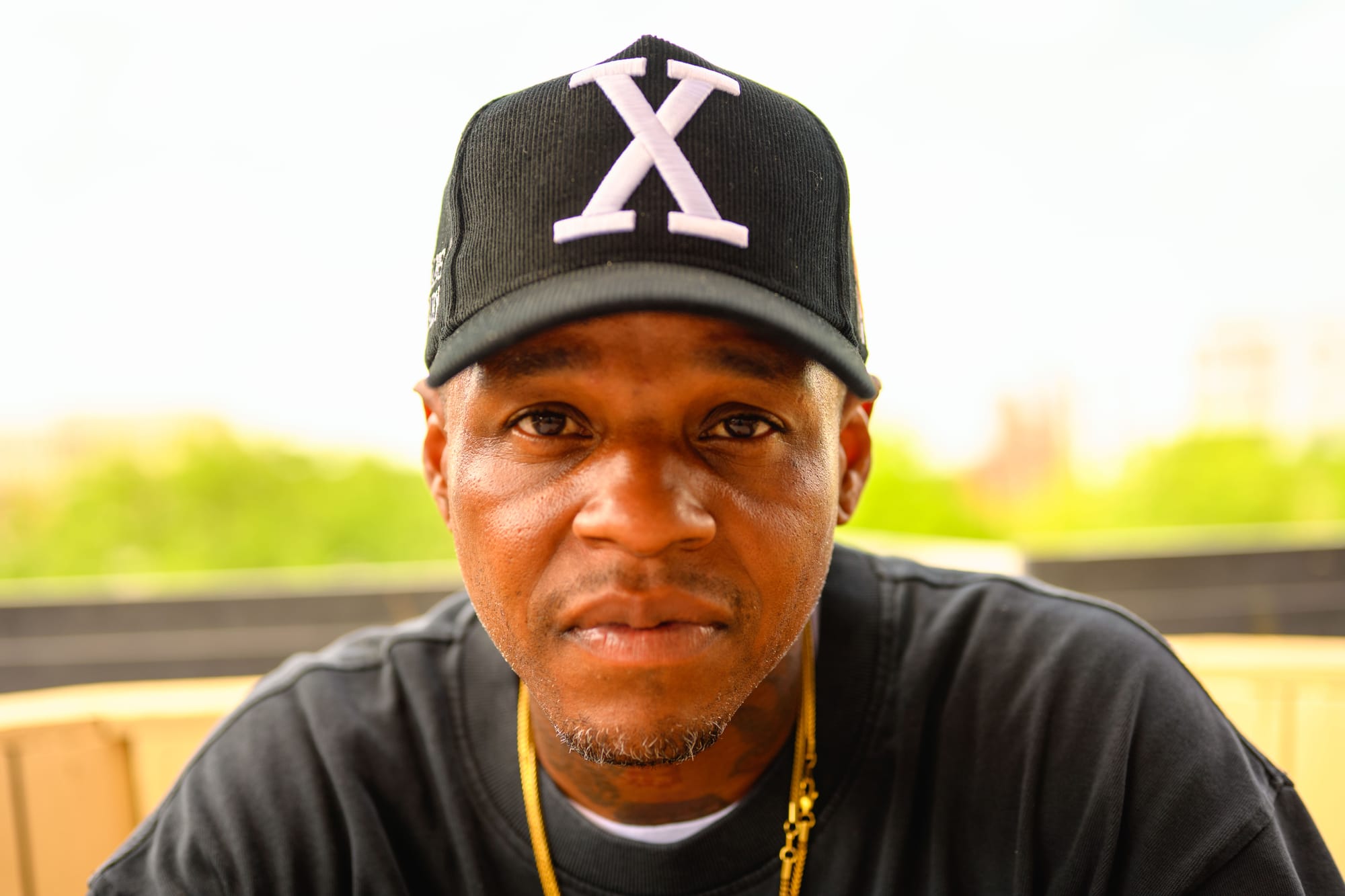
Photograph by Michael Kinney
Business and Beyond
Williams has accomplished more than he ever imagined.
The same year that Williams released Black Future, he unexpectedly received his first lesson in business. It was a tutorial that would help him create a small but growing portfolio.
He was asked to perform at the opening of the newly renovated Tower Theater in OKC. The venue, which holds 1,500 spectators, was sold out for his show.
However, Williams said, his payout was somewhere around $200, which didn’t sit right with him.
“I had a lot of local homies on the show. So, I didn’t feel like we got paid what we were supposed to get paid. If I remember right, tickets were like $15. I was like, ‘The math ain’t mathing.’ My homies are probably thinking that I shorted them because I got to pay them for performing, too. I went online and just started going off on Tower.”
Williams said the owners of the Tower Theater contacted him and wanted to make the situation right. And they were the ones who offered the then 32-year-old Williams a 10% stake in the theater as a mea culpa.
For someone who grew up seeing the value of money only displayed in straight cash, Williams really had no idea what he was getting into when he accepted the offer.
“That was my first ownership of anything. I only owned a car. I never owned a house, none of that,” he says. “I didn’t understand it at that moment. My goal has just been trying to have something that I can pass down to my children—or if something happens to me, they have ownership of something. I didn’t understand at the time. I was just going around saying, ‘I got 10%.’ But now that I’ve been doing business, I understand now what it means.”
While Williams no longer has equity in the Tower Theater, the entrepreneurial seed had been planted, and he was ready to create his own opportunities. He opened the Eastside Pizza House in 2022. With pizzas named after historical giants in Black history, the eatery instantly became part of the community. Then in 2023, he and his partner Cordell Lov opened the doors to Scrambl’d, which focuses on brunch favorites with a side of “Soul and Southern influence.” Both operations were intentionally positioned in the Clara Luper Corridor of Northeast 23rd Street, which is an area mainstream businesses have avoided in the past.
Unfortunately, Williams had to make a business decision that clashed with his community activism when he felt a need to relocate Eastside Pizza House to its current Midtown location due to lack of foot traffic.
“I ain’t cried in a long time, but that’s probably the last time I cried; when I told our staff it was closing,” Williams says. “Because we were a family. I feel like I’m the most to blame because I wasn’t in the space as much as I should have been.”
At the time, he wanted to be back out on the road touring and making music. But his roles as a community activist and business leader had grown to the point that he could no longer be away for long stretches at a time.
“If I didn’t have them, I’d be fine,” Williams says. “But I think that it’s important that we look at business, especially when it comes to the community; we look at those things not from a lens of just getting money, but how can I meet this need in the community? That’s why Scrambl’d is where it’s at. That’s why Eastside was where it was at. So, it was about meeting a need for sure.”
At the end of the day, Williams is proud of what he has been able to accomplish in all areas of his professional life. However, whenever he does take his final breath, he hopes “musician” and “business owner” are far down the list of accomplishments people will remember about him.
“Music is fun and cool, I love it, but I don’t want people to be at my funeral and somebody say, ‘Man, he sure could rap.’ Or ‘He sure could make a pizza.’ I want them to be, ‘Man, that dude helped change my life.’ I want it to be about the community.” •
The link has been copied!
Your link has expired. Please request a new one.
Your link has expired. Please request a new one.
Your link has expired. Please request a new one.
Great! You've successfully signed up.
Great! You've successfully signed up.
Welcome back! You've successfully signed in.
Success! You now have access to additional content.